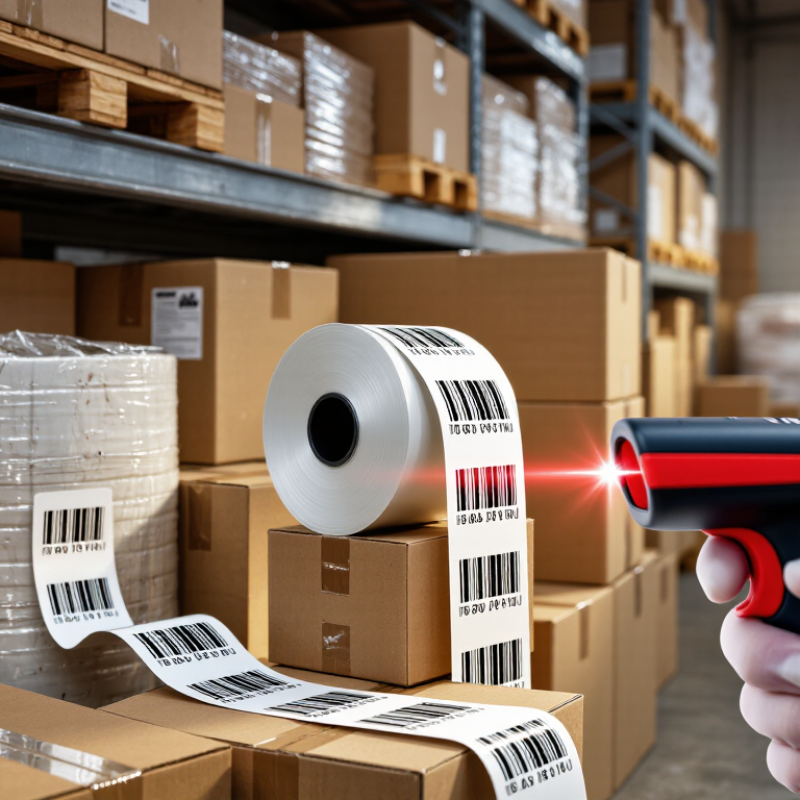
Choosing the 2026 best Warehouse Barcode Labels requires more than comparing prices or adhesive strength. Global buyers need labels that remain readable through receiving, storage, picking, export handling, and returns. A label may face dust, condensation, abrasion, cold rooms, or direct sunlight before a scanner reads it again.
Industry data supports this operational focus. Zebra Technologies’ 2023 Warehousing Vision Study reports that warehouse leaders are accelerating technology adoption to improve visibility and accuracy. Its findings also highlight growing interest in fixed industrial scanning and machine-readable identification. The 2024 MHI Annual Industry Report similarly identifies supply-chain resilience, automation, and real-time data as major investment priorities. These trends make reliable barcode media a practical infrastructure decision, not a minor purchasing detail.
GS1 standards remain an important reference for barcode structure, data quality, and global identification. Yet compliance alone does not guarantee performance. A correctly formatted barcode can still fail when printed too faintly, placed on a curved carton, or covered by stretch film. That is an easy mistake to underestimate. The best Warehouse Barcode Labels should match the application: direct thermal labels may suit fast-moving indoor cartons, while thermal transfer labels often provide stronger durability for long storage or harsh handling. Material, ribbon compatibility, print resolution, adhesive performance, and carton texture all deserve testing.
This guide compares key options for global buyers in 2026. It considers scan reliability, environmental resistance, supplier consistency, customization, and total operating cost. The “best” choice is rarely universal. Real warehouse conditions should decide.
Warehouse barcode labels are machine-readable tags that connect physical goods with digital inventory records. They usually contain printed bars, numbers, and sometimes human-readable product details. A scanner reads the pattern and retrieves information such as item code, quantity, location, or shipment status. The label itself stores limited data. The warehouse system stores the complete record.
Their main purpose is accuracy at speed. A clear label helps workers receive cartons, locate stock, pick orders, and confirm dispatches with fewer manual entries. Position matters. A label hidden under plastic wrap may scan poorly. Dust, moisture, rough cardboard, and uneven surfaces can also reduce readability. A practical check uses the actual scanner, lighting, and handling conditions found in the facility.
Common types include shelf labels, pallet labels, carton labels, product labels, and mobile asset labels. Paper labels suit clean, short-term storage. Synthetic labels perform better in damp or cold areas. Direct thermal labels are convenient for temporary identification, while thermal transfer labels usually support longer service and tougher environments. Two-dimensional codes can hold more information than traditional linear barcodes, but they still require suitable scanners and software. Not every label choice is perfect. A cheaper material may create replacement work later. Testing one sample through receiving, storage, picking, and shipping is wiser than trusting a specification sheet alone.
High-performance warehouse barcode labels must survive more than a printer test. They face forklift dust, condensation, sunlight, abrasion, and repeated handling. A clear barcode needs strong contrast, consistent bar width, and enough blank space around its edges. Small details matter.
Material selection depends on the storage environment. Coated paper suits dry indoor racks, while synthetic facestock performs better near moisture or rough surfaces. Thermal-transfer printing usually offers stronger resistance than direct thermal printing. The adhesive must match cardboard, plastic bins, painted steel, or cold surfaces. A label that peels at the corner can stop a receiving task. That is not a minor defect.
Global buyers should request sample rolls and test them in real warehouse conditions. Check scan rates from different distances and angles. Verify readability after rubbing, refrigeration, and several weeks of handling. Barcode verification equipment can identify poor print quality before shipment. Human-readable numbers remain important when a scanner fails. Local language, measurement units, and data formats may also affect usability. No label is perfect. A design that works on a clean rack may fail beside a loading door. The overlooked detail is often the real cost.
Choosing barcode labels for global warehouse operations starts with the environment, not the printer. A label crossing ports, freezers, and dusty aisles needs stable adhesion and strong contrast. Direct thermal labels suit short-term indoor use. Thermal transfer labels usually perform better for long storage, sunlight, and abrasion. Test both. Assumptions fail quickly.
The 2024 MHI Annual Industry Report found that 55% of supply chain professionals expect technology and innovation investment to rise. That investment only works when scanners read labels consistently. Select symbologies supported by GS1 standards, and verify print quality against ISO/IEC 15415 or ISO/IEC 15416. Keep quiet zones clear. Avoid placing labels across seams, curved edges, or shrink-wrap folds. A 100-by-50-millimeter label may scan well on a carton but poorly on a narrow tote.
Humidity and temperature deserve physical testing. Apply samples after condensation, cold storage, and pallet movement. Check whether corners lift after 72 hours. The 2024 State of Logistics Report placed U.S. business logistics costs at approximately 2.3 trillion dollars, showing how small handling errors can become expensive at scale. Use serialized data, readable human text, and a documented replacement process. Global sites need consistent specifications, yet local teams may use different scanners and surfaces. One label design rarely fits everything. That is the uncomfortable part. Pilot labels in three operating zones before approving a global standard.
| Label Type | Recommended Warehouse Use | Typical Face Material | Suitable Printing Method | Approximate Operating Temperature | Resistance and Expected Durability | Adhesive Guidance | Barcode Compatibility | Global Buying Considerations |
|---|---|---|---|---|---|---|---|---|
| Direct-Thermal Paper | Short-term carton labels, parcel routing, receiving, dispatch, and cross-docking | Thermal-sensitive coated paper | Direct-thermal printing; no ribbon required | Approximately 0°C to 50°C during normal use | Good indoor readability; sensitive to heat, sunlight, abrasion, oils, and plasticizer migration. Commonly suitable for temporary applications lasting several weeks to a few months. | General-purpose permanent adhesive for clean, dry corrugated cartons; freezer adhesive is needed for chilled or frozen goods. | Code 128, GS1-128, ITF-14, QR Code, Data Matrix, and other high-contrast symbols | Cost-efficient for high-volume operations, but buyers should specify liner size, core diameter, roll direction, and local recycling requirements. |
| Thermal-Transfer Paper | Inventory locations, pallet identification, product cartons, and medium-term warehouse tracking | Uncoated or coated paper | Thermal-transfer printing with a compatible ribbon | Approximately -20°C to 80°C, depending on adhesive and ribbon selection | Better resistance to smudging, light, and handling than direct-thermal paper. Typical service life ranges from several months to multiple years in protected indoor conditions. | Permanent, removable, freezer, or high-tack adhesive can be selected for the substrate and storage environment. | Code 128, GS1-128, ITF-14, GS1 DataMatrix, QR Code, and serialised warehouse labels | Suitable for global operations requiring stable print quality; ribbon availability and printer settings should be confirmed before purchase. |
| Polypropylene Film | Reusable totes, returnable containers, warehouse shelves, bins, and moderate outdoor exposure | White or clear polypropylene film | Thermal-transfer printing; resin or hybrid ribbon usually provides stronger durability | Approximately -20°C to 80°C, subject to adhesive and construction | Good resistance to moisture, tearing, and routine abrasion. Often provides multi-year performance indoors when correctly printed and applied. | Use high-tack adhesive for textured plastic, powder-coated metal, or low-surface-energy containers; removable adhesive is suitable for reusable assets. | Code 128, GS1-128, ITF-14, QR Code, Data Matrix, and asset identification symbols | A strong general-purpose option for humid regions and mixed warehouse environments; verify film thickness and recycling compatibility. |
| Polyester Film | Long-term rack labels, outdoor storage, industrial assets, machinery, and high-abrasion locations | White, silver, or clear polyester film | Thermal-transfer printing with resin ribbon; some versions support laser printing | Approximately -40°C to 120°C, depending on adhesive and label construction | Excellent resistance to water, chemicals, tearing, abrasion, and ultraviolet exposure. Often suitable for several years or longer in demanding conditions. | Permanent high-performance adhesive is recommended for metal, painted surfaces, and industrial plastics; application surface must be clean and dry. | Code 128, GS1-128, ITF-14, QR Code, Data Matrix, and high-density 2D symbols | Best for durable identification, but higher material cost and minimum-order quantities may affect international sourcing decisions. |
| Freezer-Grade Label | Frozen food, cold-chain cartons, refrigerated pallets, and temperature-controlled storage | Specially coated paper or synthetic film | Direct-thermal or thermal-transfer printing, depending on required life and exposure | Approximately -40°C to 0°C for many freezer constructions | Designed to resist condensation, low temperatures, and reduced adhesive flexibility. Durability depends strongly on thaw cycles and surface moisture. | Freezer-grade adhesive must be applied according to the supplier’s minimum application temperature; standard adhesive may fail on cold or wet cartons. | Code 128, GS1-128, ITF-14, QR Code, Data Matrix, and logistics unit labels | Specify storage temperature, application temperature, condensation level, and carton or plastic substrate before ordering. |
| Removable Asset Label | Reusable bins, rental equipment, temporary staging locations, and returnable transport items | Coated paper or polypropylene film | Thermal-transfer printing; direct thermal may be used for short-term identification | Approximately -20°C to 70°C, depending on the adhesive system | Designed for clean removal with limited residue under specified conditions; not intended for heavy abrasion or permanent outdoor exposure. | Removable adhesive should be matched to the surface energy, dwell time, temperature, and expected handling conditions. | Code 128, QR Code, Data Matrix, and internal location or asset codes | Useful for multi-country reusable packaging pools; test removal after the longest planned storage period before large-scale deployment. |
| High-Tack Industrial Label | Rough corrugated cartons, recycled packaging, textured plastics, wood, and dusty warehouse surfaces | Polypropylene, polyester, or heavy-duty coated paper | Thermal-transfer printing with a resin or hybrid ribbon | Approximately -30°C to 90°C, depending on material and adhesive | Strong bond and improved resistance to handling, moisture, and abrasion. Performance depends on surface cleanliness and sufficient pressure during application. | High-tack adhesive is recommended; buyers should confirm whether the adhesive is permanent, freezer-compatible, or suitable for low-surface-energy plastics. | Code 128, GS1-128, ITF-14, QR Code, Data Matrix, and pallet labels | Recommended where ordinary labels lift or curl; request substrate-specific adhesion testing for recycled fiber and textured containers. |
| Two-Sided or Flag Label | Cables, pipes, narrow items, cylindrical products, and small warehouse components | Polyester, polypropylene, or synthetic paper | Thermal-transfer printing; resin ribbon is preferred for handling resistance | Approximately -20°C to 80°C, subject to construction | Provides a visible barcode on items where a flat label cannot be applied. Synthetic versions resist moisture and tearing better than paper. | Use an adhesive designed for the item diameter and surface material; the flag area should not obstruct the barcode quiet zone. | Code 128, Code 39, QR Code, Data Matrix, and compact internal identification codes | Confirm label fold dimensions, barcode orientation, minimum module size, and scanner distance for automated handling systems. |
| RFID-Ready Barcode Label | High-value assets, pallet visibility, automated inventory, and operations requiring both visual and electronic identification | Paper, polypropylene, or polyester with an RFID inlay | Thermal-transfer printing; encoding requires an RFID-capable printer and verified inlay settings | Approximately -20°C to 70°C for common warehouse constructions | Durability is determined by the face material, inlay protection, adhesive, and exposure to moisture or metal. Synthetic constructions generally provide longer service life. | Choose adhesive according to the substrate; metal and liquid-rich products may require specialised RFID inlays and placement testing. | Visual Code 128, GS1-128, QR Code, Data Matrix, plus UHF RFID data encoded according to the selected supply-chain standard | Check regional radio-frequency regulations, reader compatibility, encoding requirements, data privacy rules, and carton or pallet placement constraints. |
| Pallet and Logistics Label | Shipping pallets, unit loads, cross-border distribution, and warehouse-to-warehouse transfers | Heavy-duty paper or synthetic film | Thermal-transfer printing is preferred for long-distance handling; direct thermal is suitable for short-term routes | Approximately -20°C to 70°C, depending on construction | Designed for larger formats and repeated scanning. Synthetic versions provide better resistance to rain, condensation, tearing, and pallet handling. | Permanent adhesive should be matched to corrugated board, stretch wrap, plastic, or wooden surfaces; corner lift should be checked after application. | GS1-128, ITF-14, SSCC labels, Code 128, QR Code, and Data Matrix | Use high contrast, adequate quiet zones, large print size, and consistent placement to support scanning across different countries and logistics partners. |

2026 Best Warehouse Barcode Labels for Global Buyers?
Material choice affects every scan. In dusty warehouses, coated paper often gives clear images at lower cost. For cold rooms, moisture, abrasion, and condensation require synthetic label stock. Polypropylene or polyester labels usually resist tearing better. However, stronger material can increase costs and complicate recycling. That trade-off deserves review.
Adhesive performance depends on the surface, temperature, and storage period. Permanent adhesive suits clean cardboard and plastic totes. Freezer applications need adhesive tested below the intended temperature, not merely rated for room conditions. Rough cartons, curved containers, and dusty pallets can reduce contact. A small trial is essential. One mistake is trusting the label supplier’s general temperature range without testing the actual packaging.
Printing quality directly controls scanning reliability. Thermal transfer printing supports durable images for long-term inventory records. Direct thermal printing is simpler, but heat and sunlight may darken unused labels. Choose a barcode size that matches the scanner distance. Keep strong contrast, quiet zones, and consistent print density. Test every label with the scanners used on receiving docks, racks, and forklifts. A barcode that scans once is not necessarily dependable. Verify damaged, wrinkled, angled, and partially covered labels. Global buyers should also check roll direction, core size, carton protection, and sample approval procedures before placing large orders.
2026 Best Warehouse Barcode Labels for Global Buyers?
International Standards, Compliance, and Supplier Evaluation
Reliable warehouse labels begin with readable data, not attractive printing. Choose a barcode format that matches the scanner, distance, and storage environment. Code 128 suits many shipping and inventory applications. Data Matrix works well when space is limited. ISO/IEC 15459 can support unique identification, while ISO/IEC 15418 helps organize data structures. These standards guide consistency, but they do not replace local import, recycling, or product-marking requirements.
Material selection needs practical testing. A label stored near a loading door may face dust, condensation, sunlight, and repeated handling. Test adhesion on cardboard, plastic totes, metal racks, and cold surfaces. Ask suppliers for print-quality measurements, durability results, production samples, and batch traceability. A clear scan at 30 centimeters may fail at three meters. Small details matter.
Supplier evaluation should include more than price. Review manufacturing controls, inspection records, data-security practices, replacement procedures, and communication speed. Request a pilot batch before placing a large order. Check whether the supplier can maintain identical dimensions, adhesive strength, and barcode contrast across repeat shipments. A perfect checklist is unrealistic. I would still record every failed scan, because one overlooked edge curl can interrupt an entire picking route. Compliance claims also deserve verification, not polite acceptance.
ISO/IEC 15416 traditional linear barcode quality-grade thresholds
Barcode quality is commonly reported on a 0.0–4.0 grading scale under ISO/IEC 15416. Grades A and B are generally preferred for global warehouse operations because they provide stronger print and scanning performance. Buyers should also confirm applicable GS1 identification rules, label material durability, verification records, and supplier quality-management controls.