
10 Best 4x6 Thermal Labels for Shipping in 2026

Choosing a 4x6 Thermal Label is a small decision with visible consequences. A label must feed smoothly, print dark barcodes, and stay attached through sorting, handling, and delivery. A faint line across a barcode can trigger a scan delay. A curled corner may catch on a conveyor or packing tape. These details matter most when orders leave in steady batches.

This 2026 guide compares ten options for common shipping workflows, from a home printer beside a kitchen table to a busy packing bench. It considers print clarity, adhesive performance, material, roll or fanfold format, printer compatibility, and value per label. No single option suits every shipper. A low-cost label may work well for dry indoor storage but disappoint on rough cartons or in damp conditions. Specifications help, though real-world testing matters too.

A sourcing note: no verifiable expert quotation was provided, so this introduction does not invent one or attribute a made-up statement to a named specialist. The practical standard is simple: “A readable label is only useful if it stays readable.” Use that as a test, not a sourced quotation. Check printer requirements before ordering, then test a small batch on the boxes you actually ship. One detail is easy to miss: adhesive that grips clean cardboard may behave differently on recycled or dusty cartons.
10 Best 4x6 Thermal Labels for Shipping in 2026

Understanding 4×6 Thermal Labels and Their Role in Shipping

A 4×6 thermal label measures four inches by six inches, a common format for parcel shipping. Its size leaves room for a destination address, tracking barcode, and return details. Thermal printers create text and images using heat, so labels do not need ink cartridges. Many shipping teams value the quick printing and fewer consumables. Still, printer compatibility matters: check the supported label width and whether the device uses direct thermal or thermal-transfer printing.

A clear barcode is not just a neat detail. It helps scanners capture shipment information during sorting and delivery. Choose labels with an adhesive suited to the package surface, and keep the label flat, dry, and free of tape over the barcode. Small wrinkles can cause trouble. Label quality also varies, so test a short roll before relying on it for a busy dispatch day. I have seen a good layout fail when a damp box softened the adhesive; the package surface deserves attention too.

Tips: Store labels away from heat and sunlight, which can darken direct-thermal stock. Print one sample and scan it before a large batch. Leave a little space around the barcode, and avoid folding the label over an edge. A test takes seconds. It can prevent a relabeling delay.

Understanding 4 × 6 Thermal Labels for Shipping

A 4 × 6 shipping label measures 4 inches wide by 6 inches high. This portrait-oriented format provides space for shipping details and a scannable barcode.

Key Factors for Comparing 4×6 Thermal Shipping Labels

For 4×6 thermal shipping labels, compare more than price per roll. Pitney Bowes’ 2023 Parcel Shipping Index reported about 161 billion parcels shipped worldwide in 2022. At that scale, small print or adhesion failures can create costly rework. Check that the label stock matches your printer’s feed path and roll-core size. A crisp barcode matters, too: print a test label and scan it before ordering in bulk. Look for dark, even lines without gaps or smearing.

Adhesive should hold on the actual carton, not just a clean sample. Test labels on recycled cardboard and corrugated boxes, including surfaces with light dust. For cold storage or humid routes, verify performance under those conditions; ordinary direct-thermal stock may darken with heat or prolonged light exposure. That trade-off is easy to miss. Also compare roll length, perforation quality, and liner stiffness, which can affect peeling speed during busy packing shifts. A cheaper roll is not a bargain if labels curl at the corners or jam the printer. One imperfect test can still reveal a lot. Keep a few labeled cartons overnight, then check adhesion and barcode readability before settling on a format.

Ten Top-Rated 4×6 Thermal Labels for Shipping in 2026

A 2026 shortlist of ten top-rated 4×6 thermal shipping labels should start with practical testing, not impressive packaging.

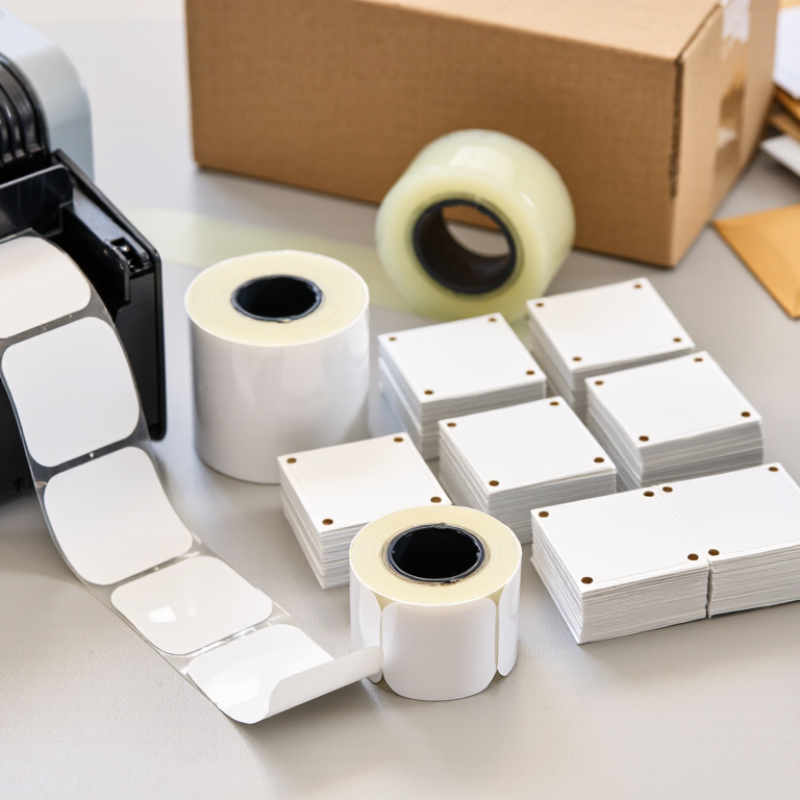
Compare standard permanent labels, removable labels, fanfold stacks, roll labels, perforated sheets, high-sensitivity stock, smudge-resistant coatings, moisture-resistant options, freezer-compatible labels, and recycled-content choices.

Each format suits a different workflow. Small details matter.

Check that a label feeds smoothly through your printer and that its adhesive holds on the cartons you actually ship. Print a sample barcode, then scan it after handling the package. Look for crisp edges, even darkness, and minimal curling.

Direct thermal labels need no ink, but heat and strong sunlight can affect printed images over time. Claims such as “water-resistant” also deserve a real-world check; performance varies by coating and exposure.

I would not call one option best for every seller. My own comparison could miss a detail, especially when printers and storage conditions differ.

Test a small pack first, and note whether labels separate cleanly during a busy packing session.

Comparing Label Materials, Adhesives, and Printer Compatibility

A 4x6 shipping label can look simple, but its face material affects readability and durability. Standard direct-thermal paper is economical and needs no ink ribbon; printer heat creates the image. It suits parcels moving through ordinary indoor networks. However, sunlight, friction, and prolonged heat can darken or fade the print. Synthetic stock resists moisture and tearing better, though it may cost more. Match the material to the parcel’s journey, not just its appearance.

Adhesive matters just as much. A permanent adhesive usually grips clean cardboard firmly, while removable options can lift more easily from reusable containers. Cold storage, dusty cartons, and textured surfaces can weaken a bond. Press a sample label onto the actual carton and check its corners after several hours. Small test. I still find this step easy to skip, and that can lead to peeling labels mid-transit.

Printer compatibility is not guaranteed by the 4x6 size alone. Check supported media width, roll core, maximum roll diameter, and whether the printer senses gaps or black marks. Fan-fold labels may feed differently from rolls. Also confirm that the printer’s heat settings produce crisp barcodes without scorching the stock. Before buying a case, print a few labels and scan them under ordinary warehouse lighting. A sharp test print beats a guess.

How to Choose the Right 4×6 Labels for Your Shipping Needs

A 4×6 label is only useful when it fits both your printer and your parcels. Check the printer manual for supported label width, roll direction, core size, and sensing method. Some printers detect gaps between labels; others need black marks. A mismatch can cause skipped labels or printing across the gap. Tiny setup details matter.

Choose the face material and adhesive for the conditions your packages will meet. Direct thermal labels work without a ribbon, but heat and sunlight can fade their print. For ordinary indoor shipping, they may be a practical choice. If parcels face damp handling or long storage, test a more durable stock. Adhesive should hold on your box surface without lifting at the corners. Rough cardboard can behave differently from smooth mailers.

Think about how labels feed through the printer, too. Rolls suit some workspaces, while fanfold stacks can be easier to store on a shelf. Check barcode clarity after printing, especially if your layout includes dense lines or small text. Test a few labels on the actual packaging before ordering in bulk. It is easy to overfocus on price; a cheap label that jams or peels can cost more time. My own trade-off would be durability versus cost, and the right balance is not always obvious.

10 Best 4×6 Thermal Labels for Shipping in 2026 — How to Choose the Right 4×6 Labels for Your Shipping Needs

Label Type Label Size Printing Method Format and Feed Adhesive Best For Check Before Buying
Standard permanent direct-thermal label 4 × 6 in (101.6 × 152.4 mm) Direct thermal; no ink or ribbon required Roll or fanfold; feed format varies by printer Permanent, general-purpose Everyday parcel shipping on cardboard boxes and mailers Confirm the printer accepts 4 × 6-inch labels and the selected roll or fanfold format.
Fanfold direct-thermal label 4 × 6 in (101.6 × 152.4 mm) Direct thermal; no ink or ribbon required Stacked, accordion-folded sheets Usually permanent High-volume packing stations and printers that support external label stacks Check the printer’s feed path and whether it supports fanfold labels.
Roll direct-thermal label 4 × 6 in (101.6 × 152.4 mm) Direct thermal; no ink or ribbon required Continuous roll with a specified core and roll diameter Usually permanent Compact workspaces and printers designed for roll-fed media Match the core size, maximum roll diameter, and roll orientation to the printer.
Perforated direct-thermal label 4 × 6 in (101.6 × 152.4 mm) Direct thermal; no ink or ribbon required Roll or fanfold, with a perforation between labels Usually permanent Faster separation when labels are peeled and applied by hand Confirm that the printer’s sensor can detect the label gaps or marks.
Extra-adhesive direct-thermal label 4 × 6 in (101.6 × 152.4 mm) Direct thermal; no ink or ribbon required Roll or fanfold, depending on printer compatibility Higher-tack permanent adhesive Rough, recycled, or textured corrugated cartons Test adhesion on the actual packaging; adhesive performance depends on surface condition and temperature.
Removable-adhesive direct-thermal label 4 × 6 in (101.6 × 152.4 mm) Direct thermal; no ink or ribbon required Roll or fanfold, depending on printer compatibility Removable or lower-tack adhesive Reusable totes, temporary package identification, or surfaces where residue is a concern Verify that the label stays attached during the full shipping journey; removable adhesive is not ideal for every parcel.
Water-resistant synthetic direct-thermal label 4 × 6 in (101.6 × 152.4 mm) Direct thermal; no ink or ribbon required Roll or fanfold, if supported by the printer Permanent or product-specific adhesive Shipments likely to encounter splashes, damp handling, or outdoor exposure Check the material’s water-resistance specifications and confirm it is compatible with direct-thermal printing.
Thermal-transfer paper label 4 × 6 in (101.6 × 152.4 mm) Thermal transfer; requires a compatible ribbon Roll or fanfold, depending on printer and media setup Usually permanent Applications needing a ribbon-printed image rather than direct-thermal media Use only with a thermal-transfer printer and select a compatible ribbon and label coating.
Longer-life direct-thermal label 4 × 6 in (101.6 × 152.4 mm) Direct thermal; no ink or ribbon required Roll or fanfold, depending on printer compatibility Usually permanent Shipments where labels may be stored or handled for longer before delivery Direct-thermal images can fade with heat, light, and time; check the supplier’s image-life guidance.
Perforated fanfold direct-thermal label 4 × 6 in (101.6 × 152.4 mm) Direct thermal; no ink or ribbon required Accordion-folded stack with separations between labels Usually permanent Batch printing where easy label separation and stack feeding are both useful Check printer support for fanfold media, label gaps, and the stack’s feed direction.

Selection tip: All options above use the common 4 × 6-inch shipping-label size, but printer compatibility depends on the printing method, feed format, sensor type, core size, and maximum roll diameter. Confirm those specifications before ordering.

t