
China Best Copper Busbar Extrusion Machine Supplier?

The global shift toward electrification is making copper processing capacity more important. The International Energy Agency reported in its Global Critical Minerals Outlook 2024 that copper demand will rise sharply through 2035, driven by power grids, electric vehicles, and renewable energy. The International Copper Association also identifies electrical applications as copper’s largest demand segment.

This pressure reaches the factory floor. A Copper Busbar Extrusion Machine must produce accurate profiles, stable surfaces, and consistent conductivity. Even a small dimensional error can create problems during switchgear assembly. Operators watch billet temperature, extrusion speed, die wear, and cooling conditions closely. The process looks straightforward. It is not.

Dr. Michael Widmer, metals strategist at Bank of America, has described copper as “the new oil,” highlighting its strategic role in modern infrastructure. His comment is broad, but it reflects a practical concern for equipment buyers: reliable copper output now affects project schedules and energy-system costs. S&P Global’s report, The Future of Copper, also warns that supply growth may struggle to match long-term demand. That gap makes machine selection more than a price comparison.

A capable Copper Busbar Extrusion Machine can reduce scrap, improve repeatability, and support larger production volumes. Yet no machine solves every production weakness. Poor rod quality, unsuitable tooling, or weak maintenance can still reduce performance. Buyers should examine verified output data, energy consumption, service response, and sample profiles before choosing a supplier. The best decision is rarely the cheapest one.
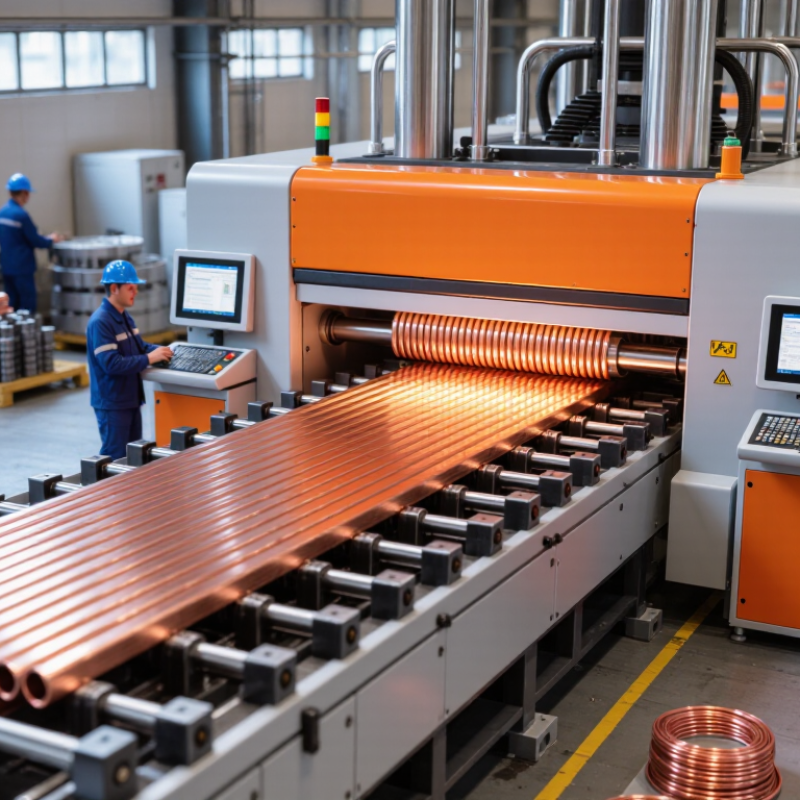
China Best Copper Busbar Extrusion Machine Supplier?

Copper Busbar Extrusion: 99.9% Pure Copper and 100% IACS Conductivity

Copper Busbar Extrusion: 99.9% Pure Copper and 100% IACS Conductivity

Selecting the right copper busbar extrusion machine requires more than checking output speed. The machine must process 99.9% pure copper with stable pressure, temperature, and alignment. High-purity copper supports excellent electrical performance, but conductivity can change after extrusion. Heat, surface oxidation, impurities, and excessive deformation may reduce the final result. A reliable supplier should explain these risks clearly. They should also provide material certificates, dimensional records, and conductivity test data. In practical production, a smooth busbar surface matters. Small scratches can complicate plating, bending, and insulation. Precision is not optional.

Tips: Confirm conductivity at the actual finished condition, not only from the raw copper certificate. Ask for testing at 20°C, using the IACS reference method. Check sample dimensions, corner radius, cooling control, and die wear. Request a trial extrusion before placing a large order. It is a modest step.

The phrase “100% IACS conductivity” needs careful interpretation. It usually refers to annealed copper under defined testing conditions, not every extruded busbar. A strong machine design should control billet heating, extrusion speed, cooling, and straightening. These details protect the copper’s structure and reduce distortion. Experienced technical support can help adjust the process for different widths and thicknesses. Still, no supplier should promise perfect results without testing. That promise sounds attractive, but it deserves questioning. A better evaluation compares measured samples, production consistency, energy use, and maintenance response.

How Copper Extrusion Machines Operate at 700–900°C Processing Temperatures

China Best Copper Busbar Extrusion Machine Supplier?

Copper extrusion machines usually process billets between 700 and 900°C. This range softens copper without reaching its melting point. The heated billet enters a strong steel container. A hydraulic ram then pushes it through a precision die. The die controls the busbar’s width, thickness, and corner shape. Temperature drift matters. Even a small variation can change metal flow and surface quality.

In practical production, technicians monitor billet temperature, die temperature, ram speed, and extrusion pressure. Thermocouples provide useful readings, but they do not measure every point inside the billet. This limitation deserves attention. A billet may appear ready while its center remains cooler. Uneven heating can create rough edges, cracks, or dimensional movement after cooling. Experienced operators adjust heating time and pressing speed carefully.

After extrusion, the hot busbar passes through a controlled cooling area. Cooling must be gradual enough to reduce distortion, yet fast enough for stable handling. Workers then check thickness, straightness, conductivity, and visible surface defects. A reliable machine supplier should provide test records, maintenance guidance, and process training. The supplier should also explain die life and temperature-control accuracy clearly. No setup is perfect; careful inspection still catches problems that instruments miss.

Key Machine Specifications: 500–2,000-Ton Force and 5–20 m/min Output

China Best Copper Busbar Extrusion Machine Supplier?

When evaluating a copper busbar extrusion machine, force and output deserve practical attention. A 500–2,000-ton press range covers many production requirements. Lower force can suit narrower busbars and moderate extrusion ratios. Higher force supports larger cross-sections and tougher copper grades.

Speed matters. A rated output of 5–20 m/min can improve productivity, but speed alone proves little. Stable output depends on billet temperature, die design, lubrication, cooling, and straightening control. In factory trials, operators should check whether the machine maintains dimensional accuracy at different speeds. A fast line with uneven thickness creates expensive rework. Not always better.

From my experience reviewing extrusion equipment, reliable suppliers provide measured data rather than attractive estimates. Ask for press force, maximum billet diameter, container dimensions, motor power, and real production speed. The control system should record pressure, temperature, and line speed during each run. These records help engineers trace surface marks or bending problems.

A 2,000-ton machine may look impressive, yet it can be excessive for a small busbar range. It may also increase energy use and maintenance demands. Conversely, a 500-ton press may struggle with large profiles. This is where supplier expertise matters. Request sample extrusion results using your copper grade, target dimensions, and required tolerance. Leave room for doubt. Actual workshop conditions often expose weaknesses that brochures do not mention.

China Copper Busbar Extrusion Machine: Force and Output Range

The chart presents representative operating points within the specified 500–2,000-ton force and 5–20 m/min output ranges. Actual performance depends on copper alloy, busbar cross-section, die design, billet temperature, and cooling conditions.

Reference range: 500–2,000 tons of extrusion force and 5–20 m/min line output. Values are specification-range reference points, not company or brand performance data.

China Supplier Evaluation: Tooling Accuracy, Energy Use, and ISO 9001 Compliance

China Best Copper Busbar Extrusion Machine Supplier?

China Supplier Evaluation: Tooling Accuracy, Energy Use, and ISO 9001 Compliance

Selecting a copper busbar extrusion machine requires more than comparing quoted output. In a supplier evaluation, tooling accuracy deserves close inspection. Ask for die drawings, material certificates, and recent dimensional reports. Measure sample busbars across width, thickness, and corner radius. Small errors can create poor bends and electrical losses. A stable die should hold tolerances during long production runs, not only during demonstrations. Request a trial using your copper grade and target profile. The trial matters.

Energy use needs evidence, not optimistic numbers. Compare kilowatt-hours per tonne at a defined production speed. Record heater zones, motor load, cooling demand, and idle consumption. Ask whether readings come from calibrated meters. A lower figure may hide slower output or excessive scrap. Review warm-up time too. It affects smaller batches. Inspect insulation, drive settings, and heat recovery options. These details reveal operating discipline. Still, calculations can be messy.

ISO 9001 compliance should be visible in daily records. Check incoming copper inspections, die maintenance logs, calibration dates, and nonconformance reports. Ask how corrective actions are verified after closure. A certificate alone proves little. During a factory visit, compare procedures with operator habits. Look for labeled gauges, controlled drawings, and traceable batch records. Some suppliers present excellent documents but weak floor control. That gap deserves honest discussion. Reliable purchasing also includes service response, spare tooling access, training, and acceptance testing. Leave room for doubt.

China Best Copper Busbar Extrusion Machine Supplier? - China Supplier Evaluation: Tooling Accuracy, Energy Use, and ISO 9001 Compliance

Anonymous supplier-evaluation framework with measurable procurement benchmarks

Evaluation Dimension Recommended Benchmark Evidence to Request Weight Evaluation Notes
Tooling material Hardened tool steel or equivalent die material suitable for hot copper extrusion Material certificate, heat-treatment record, and die-life history 10% Confirm hardness, toughness, thermal-fatigue resistance, and compatibility with the selected copper grade.
Die and tooling accuracy Critical die dimensions controlled to approximately ±0.02–0.05 mm, subject to profile complexity Coordinate-measuring-machine report, drawing tolerances, and inspection plan 15% The final tolerance must be agreed in the approved die drawing; tighter tolerances may increase tooling cost.
Profile dimensional stability Production capability demonstrated by Cp/Cpk data; Cpk ≥ 1.33 is a common acceptance target for stable critical characteristics Pilot-run measurements, control charts, and capability study 15% Review width, thickness, corner radius, straightness, and twist separately rather than relying on one average value.
Copper grade compatibility Machine and die design validated for the specified copper grade, such as high-conductivity electrolytic copper Approved material list, process parameters, and sample chemical or conductivity test results 10% Electrical conductivity and mechanical properties should be confirmed against the purchase specification and applicable standard.
Energy consumption Measure specific energy consumption in kWh per tonne of accepted product during a defined production trial Calibrated power-meter records, production output, scrap quantity, and operating conditions 15% Do not compare figures unless billet size, alloy, profile area, line speed, heating method, and scrap rate are comparable.
Heating and temperature control Closed-loop temperature monitoring with documented set-point and actual-temperature records Thermocouple calibration certificates, trend data, alarm settings, and maintenance records 10% Stable billet and die temperatures help reduce surface defects, dimensional variation, and unnecessary energy use.
ISO 9001 compliance Valid ISO 9001 certificate covering the manufacturing site and relevant scope Certificate number, scope, validity dates, certification body, and latest audit status 10% ISO 9001 confirms a quality-management system; it does not by itself guarantee machine performance or product quality.
Factory acceptance testing Documented FAT covering output, dimensions, safety functions, alarms, and repeatability Signed FAT protocol, test samples, measurement reports, and corrective-action records 10% Use customer-approved acceptance criteria and retain samples for comparison during installation and commissioning.
After-sales service and spare parts Documented response process, recommended spare-parts list, manuals, and remote-support capability Service-level commitment, parts lead times, troubleshooting procedure, and training plan 5% Evaluate total ownership cost, not only the initial machine price.
Total Evaluation Weight 100% Use verified documents and witnessed testing before final supplier selection.

Note: The numerical ranges above are procurement targets or commonly used quality benchmarks, not performance claims for any specific supplier. Final requirements should be confirmed through the approved technical specification, pilot extrusion trial, and contract acceptance protocol.

Quality Tests for Busbars: Dimensions, Surface Finish, Conductivity, and Tensile Strength

China Best Copper Busbar Extrusion Machine Supplier?

Quality testing decides whether an extruded copper busbar performs reliably in service. Experienced inspectors measure width, thickness, corner radius, and straightness with calibrated tools. Measurements should be taken at several points, not only near the end. Small variations can affect fitting and electrical clearance. Record the results against the approved drawing and required tolerance.

Surface finish deserves close attention. Inspectors look for scratches, cracks, dents, oxidation, and die lines under strong, even lighting. A smooth busbar may still contain hidden stress. Conductivity testing then checks electrical performance using a calibrated instrument and a controlled temperature. Copper purity, temperature, and contact pressure can influence readings. Tensile testing provides another useful view. Test samples are pulled until failure, revealing tensile strength and elongation. One weak sample should not be ignored. It may indicate unstable extrusion conditions. Testing is not perfect, and poor sampling can create false confidence.

Tips: Clean test surfaces before conductivity checks. Verify instrument calibration. Keep sample locations traceable. Compare repeated results, not just one attractive number. A reliable extrusion machine supplier should provide inspection records, material certificates, and practical support for corrective actions. Ask how operators control billet temperature, extrusion speed, and die wear. These details often explain inconsistent dimensions or surface marks. Some production teams overlook them. That mistake is worth reviewing.

t