
How to Choose the Right Modbus Converter for Your System?
Choosing the right Modbus Converter begins with the system, not the product catalogue. A legacy PLC may speak Modbus RTU through RS-485, while a modern SCADA server expects Modbus TCP over Ethernet. The converter must bridge both sides reliably. It should also match baud rate, parity, slave addressing, isolation, and diagnostic requirements. Small details matter. A missing termination resistor can create intermittent faults inside a noisy control cabinet.
Industry data shows why this decision remains important. HMS Networks’ Industrial Network Market Shares 2024 report found that Ethernet-based networks represented 71% of newly installed industrial nodes, while traditional fieldbus systems still held 29%. ARC Advisory Group’s industrial networking research also describes continued migration from serial systems toward Ethernet architectures. The transition is not complete. Many factories still operate drives, meters, sensors, and PLCs built around Modbus RTU.
Industrial networking author John Rinaldi offers a practical warning: “The most important part of any gateway is understanding what must be communicated.” That principle applies directly to Modbus Converter selection. Confirm the required register types, polling speed, cable distance, and failure behavior before comparing brands. Check whether the device supports electrical isolation, web diagnostics, firmware updates, and secure network practices recommended by NIST SP 800-82 Rev. 3.
A fast converter is not always the best converter. Compatibility comes first. Yet specifications can be incomplete. Test the device with your actual PLC and field equipment, if possible. A short bench test may reveal timing conflicts that a polished datasheet never mentions.
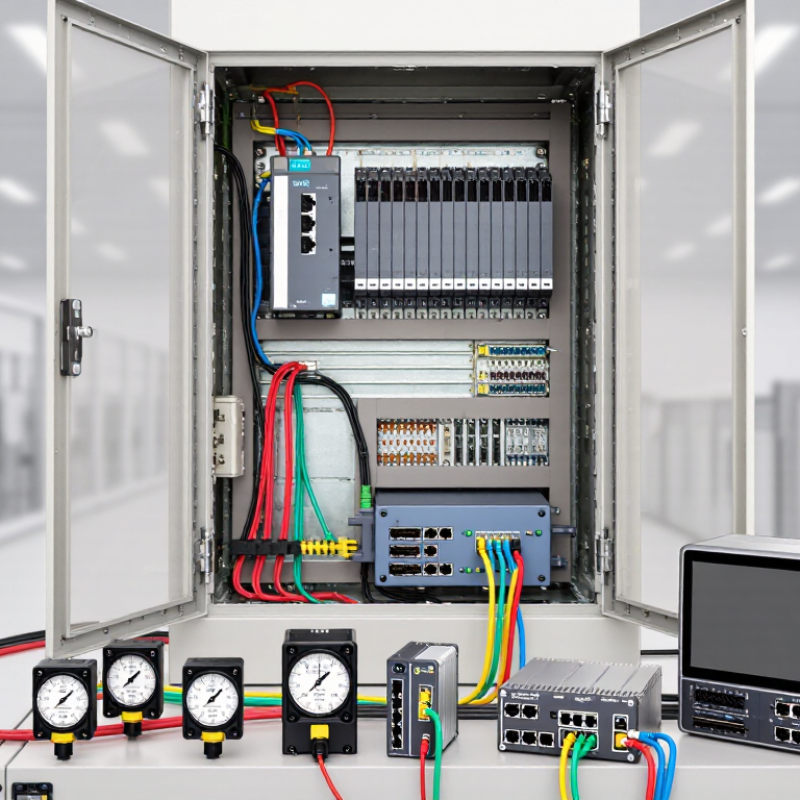
Define Your System’s Communication and Integration Requirements
How to Choose the Right Modbus Converter for Your System?
Define Your System’s Communication and Integration Requirements
Choosing a Modbus converter starts with the system, not the device catalog. Identify every interface first: RS-232, RS-485, Modbus RTU, Modbus ASCII, or Modbus TCP. Then record baud rate, parity, slave addresses, register types, and polling intervals. Small details matter. A mismatched parity setting can stop an entire data exchange.
The 2024 Industrial Network Market Share study reported that industrial Ethernet represented 71% of newly installed nodes, while fieldbus held 22%. This shift makes protocol conversion increasingly common in mixed-generation plants. However, Ethernet availability does not guarantee compatibility. Confirm whether the converter supports TCP client, TCP server, or gateway operation. Check register mapping limits and response-time behavior under peak traffic. A converter may work perfectly in a laboratory, then fail beside noisy motors.
Measure twice. Install once.
Physical conditions also define the requirement. For long RS-485 runs, examine electrical isolation, termination, grounding, and surge protection. For outdoor cabinets, check temperature and ingress ratings. For critical processes, ask about diagnostics, event logs, redundant power, and recovery after network loss. Security deserves attention too. Disable unused services and separate control traffic from general office networks.
Engineers sometimes select the cheapest converter and correct the gaps later. That approach is understandable, but it often creates hidden labor. Write a short integration test before purchasing. Include real register values, cable length, polling load, and a simulated communication failure. If the converter passes only ideal conditions, the specification is incomplete.
How to Choose the Right Modbus Converter for Your System? - Define Your System’s Communication and Integration Requirements
| System Dimension | Requirement to Define | Common Technical Options | Recommended Converter Characteristics | Key Verification Points |
|---|---|---|---|---|
| Modbus Protocol | Identify whether the equipment uses serial Modbus RTU/ASCII or Ethernet-based Modbus TCP. | Modbus RTU Modbus ASCII Modbus TCP | Use a serial-to-Ethernet converter for RTU/ASCII devices that must communicate with a TCP-based supervisory system. Use a protocol gateway when register mapping or protocol conversion is required. | Confirm the converter supports the required operating mode, function codes, and register addressing format. |
| Physical Interface | Match the converter ports with the interfaces already installed in controllers, meters, sensors, or PLCs. | RS-232 RS-485 Ethernet Fiber | Choose RS-485 for multidrop industrial serial networks, RS-232 for point-to-point connections, and Ethernet for IP-based integration. | Check connector type, pinout, signal direction, cable type, and whether an Ethernet speed of 10/100 Mbps or higher is needed. |
| Network Topology | Determine the number of devices, cable branches, and communication segments in the network. | Point-to-point Multidrop bus Star via Ethernet | For RS-485, select a converter designed for a two-wire or four-wire bus and the required number of serial ports. For Ethernet integration, verify TCP client, TCP server, or gateway operation. | RS-485 should generally use a daisy-chain bus with proper termination; avoid uncontrolled star branches and excessive stub lengths. |
| Serial Communication Settings | Match the serial parameters configured in every connected Modbus device. | Typical settings include 1,200 to 115,200 baud, 7 or 8 data bits, even/odd/none parity, and 1 or 2 stop bits. | Select a converter with configurable baud rate, parity, data bits, stop bits, and response timeout. Auto-detection can simplify commissioning but should not replace manual verification. | All devices on the same RS-485 segment normally share the same serial format; each device must have a unique Modbus address. |
| Data Flow and Operating Mode | Define whether the converter only transports data or also manages protocol and register translation. | Transparent bridge TCP server TCP client Gateway | Use transparent mode when the upper-level system already handles Modbus messages. Use gateway mode when devices use different protocols, register maps, or data formats. | Confirm the maximum number of TCP connections, serial request queue behavior, polling method, and supported function codes. |
| Distance and Transmission Rate | Estimate cable length, baud rate, electrical noise, and the quantity of connected nodes. | RS-485 networks commonly support distances up to approximately 1,200 m under suitable conditions at lower baud rates; higher speeds reduce practical reach. | Choose a converter with an appropriate serial rate, buffering capacity, and surge protection. Use fiber or additional network infrastructure for long or electrically harsh links. | Actual distance depends on cable impedance, shielding, termination, topology, baud rate, grounding, and electromagnetic interference. |
| Electrical Isolation | Assess ground-potential differences, long cable runs, motor drives, and other sources of transient voltage. | Non-isolated Serial-isolated Port-isolated | Prefer galvanic isolation between serial ports and power or Ethernet circuits when equipment is distributed across panels or connected to noisy industrial systems. | Review isolation voltage, surge rating, common-mode limits, and the required grounding and shield connection method. |
| Power Supply | Match the converter with the available control-panel or field-device power source. | 5 VDC 9–36 VDC 12–48 VDC PoE | Select a wide-range DC input for industrial panels and verify polarity protection, power consumption, and startup behavior. Use PoE only when the network infrastructure supports it. | Confirm input voltage tolerance, terminal polarity, grounding requirements, and whether a backup supply is needed for continuous operation. |
| Industrial Environment | Define installation location, temperature range, humidity, vibration, dust, and enclosure requirements. | Control cabinet Panel mount DIN rail Field enclosure | Choose an industrial-rated unit with a suitable operating temperature range, robust enclosure, DIN-rail or panel mounting, and appropriate ingress protection for the installation area. | Check operating temperature, relative humidity limits, vibration resistance, mounting clearance, and enclosure rating. |
| Network Security | Determine how the converter will be connected to the plant network or a remote monitoring system. | Private LAN VLAN VPN Firewall zone | Select a device supporting static IP configuration, access control, configurable service ports, and secure remote-access architecture where required. | Disable unused services, change default credentials, restrict management access, and avoid exposing Modbus TCP directly to the public Internet. |
| Diagnostics and Maintenance | Define the level of visibility needed for commissioning, troubleshooting, and long-term operation. | LED indicators Web interface Event logs Packet capture | Choose a converter with serial and Ethernet activity indicators, configuration backup, event logging, and accessible diagnostic tools. | Verify firmware update procedures, configuration recovery, time synchronization, log storage, and replacement-unit commissioning steps. |
| Scalability and Future Integration | Estimate future device additions, additional protocols, and expansion of the supervisory or control system. | Single-port Multi-port Modular gateway | Select spare serial ports, adequate connection capacity, and configurable mapping when the system may grow or combine multiple Modbus segments. | Review maximum device count, transaction throughput, simultaneous connections, memory capacity, and firmware upgrade support. |