
China Top Cat Stained Glass Suncatchers Supplier
China has become an important source of handcrafted decorative glass, and cat stained glass suncatchers are gaining attention among retailers, interior designers, and gift brands. These pieces combine colored glass, lead-free solder options, textured surfaces, and carefully shaped metal frames. When sunlight passes through blue, amber, or emerald glass, a cat silhouette can cast soft color across a window ledge or wall.
A reliable Chinese supplier should offer more than attractive product photos. Practical experience matters. Buyers need clear information about glass thickness, frame materials, hanging hardware, packaging, and production capacity. Skilled makers usually inspect each joint, smooth sharp edges, and test the hanging loop before shipment. Custom services may include different cat poses, seasonal themes, private labels, and retail-ready boxes. Small details matter.
Quality control is never perfect.
For this reason, professional communication remains essential. A dependable supplier should provide samples, realistic lead times, inspection records, and transparent responses about defects or delays. Export experience also helps reduce misunderstandings involving product specifications, labeling, and destination-market requirements. Buyers should confirm these details independently before placing larger orders.
This guide introduces how to evaluate China cat stained glass suncatchers suppliers through craftsmanship, customization, consistency, and service. It also considers common weaknesses, because even experienced factories may struggle with color variation or complex packaging. The best partnership is not based on promises alone. It grows through samples, documented standards, careful feedback, and repeatable results.
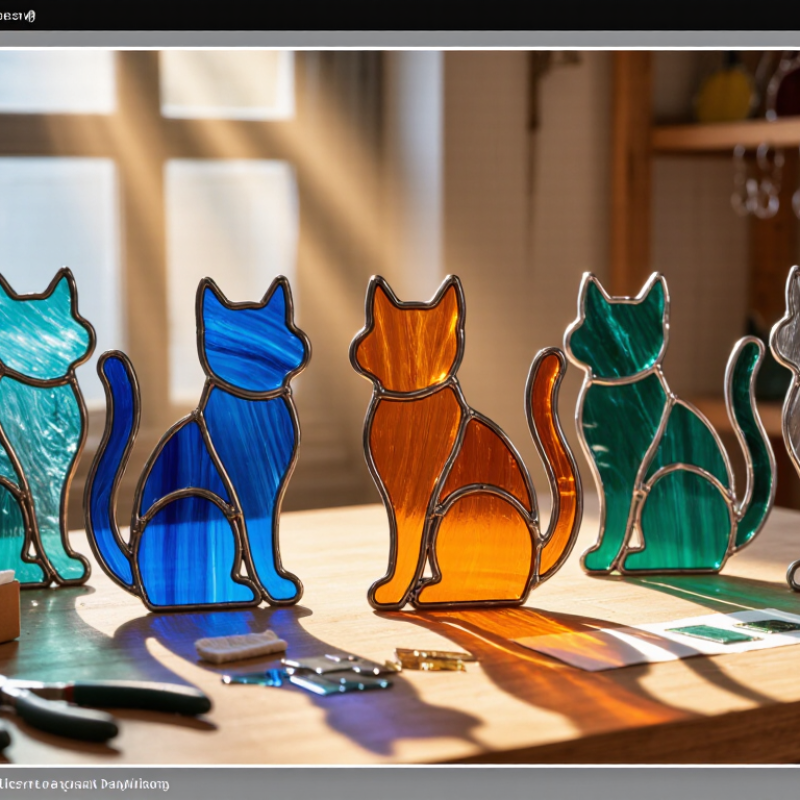
Product Definition: Cat Suncatchers Made with 2–6 mm Stained Glass
Cat suncatchers made with 2–6 mm stained glass combine decorative charm with practical material choices. Thin 2 mm glass allows softer light and lighter hanging weight. It suits small cat silhouettes and detailed ears, tails, or whiskers. Thicker 4–6 mm glass feels stronger and creates richer color depth. However, it also needs stronger edge finishing and secure hardware.
Experienced stained glass suppliers inspect every sheet for chips, surface marks, and uneven color before cutting. Skilled makers shape each cat panel carefully, then join the pieces with suitable foil, came, or reinforced seams. The final structure should hang evenly beside a bright window. A reliable supplier also checks soldered joints, hanging loops, protective wrapping, and package stability.
Small differences are normal. Handmade glass may show slight bubbles, texture changes, or gentle color variation. That is part of its character, though quality control should still prevent sharp edges and weak connections. I have found that customers often focus on color first, then notice weight and mounting needs later. This is worth discussing earlier. A thoughtful China-based supplier can provide thickness options, sample photos, dimensions, and packing details before production. Not every cat shape works equally well. Very narrow tails can become fragile, so the design may need a modest adjustment.
China Top Cat Stained Glass Suncatchers Supplier - Product Definition: Cat Suncatchers Made with 2–6 mm Stained Glass
| Product Dimension | Typical Specification or Range | Product Definition and Practical Notes |
|---|---|---|
| Product Type | Cat-shaped stained glass suncatcher | A decorative hanging panel designed to transmit and reflect daylight through colored glass. |
| Primary Material | Colored or clear stained glass, copper foil or lead came, solder, hanging hardware | The glass provides the visual color effect, while the metal joining method supports the individual glass pieces. |
| Glass Thickness | 2–6 mm | The thickness range stated in the product definition. Actual thickness may vary by glass type and design section. |
| Common Finished Size | Approximately 8–30 cm in the longest dimension | Compact sizes are suitable for windows, small wall areas, indoor plant spaces, and seasonal displays. |
| Typical Shape | Sitting cat, curled cat, stretching cat, cat face, or cat silhouette | The outline can be produced with curved, geometric, or mixed glass sections. |
| Color Options | Transparent, opalescent, textured, iridescent, and mixed-color glass | Color appearance changes with daylight direction, viewing angle, glass texture, and background. |
| Surface Appearance | Smooth, rippled, hammered, stippled, wispy, or lightly textured | Textured surfaces can diffuse light and create additional visual variation compared with fully smooth glass. |
| Joining Method | Copper-foil soldering or lead-came construction | Copper foil is commonly used for small detailed shapes; lead came is suitable for designs with stronger linear framing. |
| Edge Treatment | Soldered perimeter, metal frame, or decorative wire border | A finished edge helps protect the glass perimeter and provides a location for hanging hardware. |
| Hanging Hardware | Metal loop, eye screw, jump ring, chain, cord, or suction-cup hanging set | Hardware selection should match the product weight and the intended indoor installation surface. |
| Light Transmission | Varies from transparent to semi-opaque depending on glass type | Transparent glass transmits more daylight; opalescent and heavily textured glass produce a softer, diffused effect. |
| Weight | Typically about 100–800 g, depending on size, thickness, frame, and hardware | The finished weight should be confirmed for each design before selecting a hanging method. |
| Dimensional Tolerance | Usually about ±2–5 mm for small handmade designs | Hand-cut glass and soldered construction may create minor differences in outline, alignment, and overall dimensions. |
| Color Tolerance | Natural variation may occur between glass sheets or production batches | Printed or dyed color references should be treated as guides because transmitted light can change perceived color. |
| Recommended Use | Indoor windows, sunrooms, covered porches, galleries, gift displays, and decorative wall spaces | The product is primarily decorative and should be installed where it is protected from impact and excessive movement. |
| Outdoor Installation | Suitable only in sheltered outdoor locations when the materials and finish are specified for outdoor exposure | Direct rain, salt air, freezing conditions, and strong wind may accelerate metal oxidation or damage the hanging assembly. |
| Safety Characteristics | Rigid decorative glass; not a safety-glazing product | It should not be used as a window panel, guard, door insert, or structural glazing component. |
| Care Instructions | Dust with a soft dry cloth; use a slightly damp cloth when necessary; dry thoroughly | Avoid abrasive cleaners, strong acids, prolonged soaking, and pressure on individual glass pieces or solder joints. |
| Packaging Requirements | Protective wrapping, edge cushioning, rigid inner support, and a crush-resistant outer carton | Packaging should prevent glass-to-glass contact and limit movement during handling and transport. |
| Pre-Shipment Inspection | Check dimensions, glass chips or cracks, solder continuity, hanging points, surface cleanliness, and packaging condition | Inspection criteria should be agreed before production, especially for handmade or customized designs. |
| Customization Options | Cat pose, outline, glass palette, texture, size, border style, hanging method, and gift packaging | Customization feasibility depends on the selected glass thickness, design complexity, production method, and order quantity. |
| Product Positioning | Handcrafted decorative home accessory and gift item | The combination of cat imagery and colored light makes the product suitable for pet-themed, nature-themed, and seasonal collections. |