
Choosing China’s top Dog Food manufacturers requires more than comparing prices, factory photos, or attractive packaging. Global buyers need evidence of consistent quality, transparent sourcing, and reliable production systems. A serious supplier should explain ingredient origins, batch testing, moisture control, storage conditions, and recall procedures clearly.
Dr. Lisa M. Freeman, a veterinary nutritionist at Tufts University, has stated, “There is no one best diet for all pets.” This principle matters when evaluating Chinese manufacturers. A suitable product depends on the dog’s age, size, health needs, activity level, and feeding environment. Buyers should therefore examine nutritional formulation, feeding trials, laboratory results, and label accuracy instead of trusting marketing language alone.
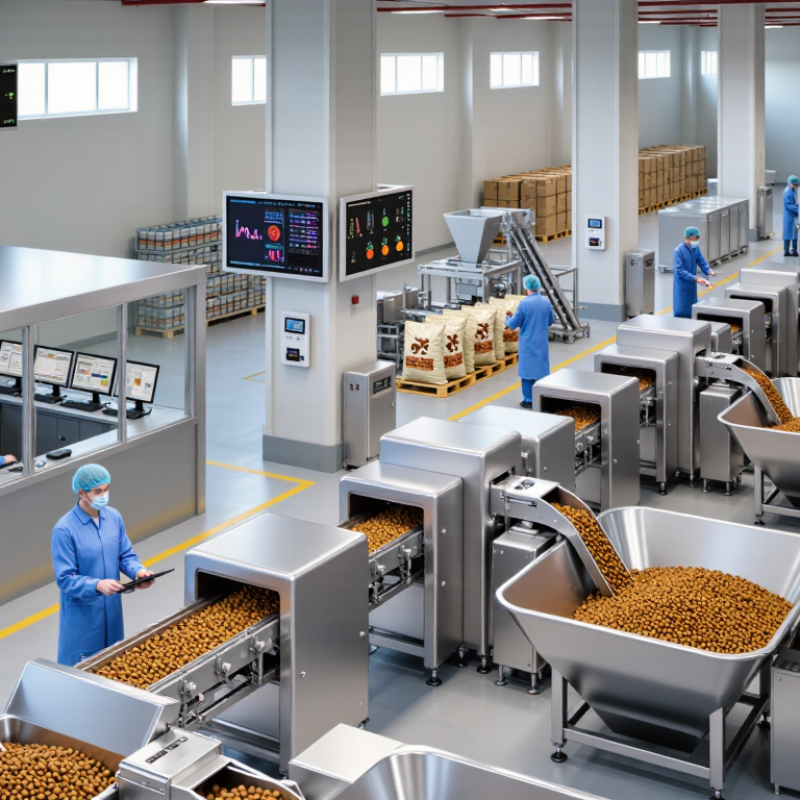
The strongest manufacturers usually maintain documented quality systems and welcome independent audits. Their facilities may include stainless-steel mixing lines, controlled drying chambers, sealed packaging rooms, and retained samples from every batch. These details show operational discipline. They do not guarantee perfection.
No factory is flawless.
Supplier evaluation should also consider communication speed, minimum order quantities, export experience, packaging flexibility, and technical support. A manufacturer may offer excellent kibble but struggle with shipment planning or reformulation requests. Another may provide competitive prices while giving vague answers about testing. That uncertainty deserves attention.
This guide compares leading China-based Dog Food manufacturers through practical buyer criteria. It focuses on manufacturing capability, product safety, customization, documentation, and long-term reliability. Some conclusions may change as facilities upgrade, certifications expire, or ingredient markets shift. Buyers should verify current records independently before signing contracts. Careful questions often reveal more than polished presentations.
China’s dog food market expanded in 2024, supported by rising urban pet ownership and online purchasing. Statista Market Insights estimated China’s pet food revenue at approximately US$15 billion in 2024. Its forecast also indicated steady annual growth through 2028. The 2024 China Pet Industry White Paper reported stronger spending on complete diets, treats, and functional nutrition. Market estimates differ. Some include treats, while others measure dog and Cat Food separately.
Export data requires careful reading. China Customs classifies dog and cat food together under HS 230910. UN Comtrade records show China’s exports in this category exceeded US$1 billion in 2023, with overseas demand remaining active in 2024. The figure is not dog-only. That distinction matters. Global buyers should verify factory capacity, batch traceability, ingredient documentation, and moisture-barrier packaging before comparing quotations. A low price can hide higher logistics or testing costs. Export growth also varies by destination, currency, and product category.
In practical sourcing, buyers may request recent production records, laboratory reports, and samples from three separate batches. Ask for evidence. Industry reports describe strong growth, but reported numbers are not perfectly consistent. This remains a weakness in market analysis.
China Top Dog Food Manufacturers for Global Buyers?
Manufacturer Types: OEM, ODM, and Private-Label Capacity Metrics
Choosing a Chinese dog food manufacturer requires more than checking factory size. OEM production suits buyers with approved recipes, ingredient specifications, and packaging designs. The factory mainly executes your plan. ODM suppliers offer existing formulas that can be adjusted for nutrition, texture, shape, or flavor. Private-label production usually combines formulation, manufacturing, packaging, and export documentation under the buyer’s label.
Capacity must be measured in practical terms. Ask for monthly output by product type, not one total figure. Dry food capacity may differ greatly from canned or freeze-dried capacity. Check extrusion lines, drying time, packing speeds, minimum order quantities, and realistic lead times. A plant may produce 500 tons monthly but still need three weeks for custom bags. Small details matter. Packaging can become the bottleneck.
Reliable evaluation includes batch records, ingredient traceability, laboratory testing, and documented quality checks. Request recent test samples and compare them with approved specifications. Review food safety systems, production licenses, export experience, and recall procedures. I once treated stated monthly tonnage as proof of readiness; the packaging schedule later showed a different picture. Capacity claims need verification. Factory visits, video inspections, and independent testing can reveal gaps. Buyers should also confirm whether formulas are exclusive, how revisions are controlled, and who owns the finished artwork. A clear production agreement reduces costly misunderstandings, although no document removes every operational risk.
For global buyers, AAFCO’s numbers provide a practical screening point. The 2024 AAFCO Official Publication lists adult-maintenance dog food at 18% minimum crude protein and 5.5% minimum crude fat, measured on a dry-matter basis. These values are not universal targets. They apply to adult maintenance diets, not growing puppies or pregnant dogs.
Read the label carefully. A food containing 18% protein “as fed” may fall below that level after moisture adjustment. For example, 18% protein at 10% moisture equals 20% dry matter protein. The calculation is simple: nutrient percentage divided by dry matter percentage.
Small errors matter. I have seen supplier comparisons fail because buyers mixed these two measurement systems.
AAFCO profiles are useful, but they do not measure protein digestibility, amino-acid balance, oxidation, or manufacturing consistency. The National Research Council’s Nutrient Requirements of Dogs and Cats emphasizes biological availability, not crude percentages alone. FEDIAF’s 2024 Nutritional Guidelines also support evaluating energy density and life stage. Responsible manufacturers should provide batch testing, ingredient specifications, and laboratory methods.
A certificate alone is not enough. Human review still matters.
Global buyers increasingly examine quality systems before comparing dog food prices. APPA’s 2024 State of the Industry Report recorded US pet industry spending of $150.6 billion in 2023. FEDIAF’s 2024 facts report valued Europe’s pet food market at €29.3 billion in 2023. These figures show why documented safety controls matter across export supply chains.
GB/T 31216-2014 is a Chinese product standard for complete dog food, not a factory certification. It supports checks on formulation, nutrition, labeling, and product safety. Buyers should request laboratory results, ingredient traceability, and batch records linked to this standard. HACCP should identify hazards from receiving through cooking, drying, packing, and storage. ISO 22000 adds a broader food safety management structure, including verification, communication, and corrective actions.
Certificates need careful reading. Check the certification scope, production site, validity period, and independent audit body. Ask for recent recall simulations and environmental monitoring records. Small details matter.
In factory audits, clean zoning and sealed sample bags often reveal more than polished brochures. Yet paperwork alone is not enough. A supplier may hold valid certificates while performing weak root-cause analysis after a failed test. That gap deserves attention. Buyers should compare corrective-action evidence, not merely certificate logos, and retain independent samples for pre-shipment testing.
| Quality Dimension | Applicable Standard or Control | Factual Requirement or Benchmark | Evidence Global Buyers Should Request | Export Relevance |
|---|---|---|---|---|
| Product Standard | GB/T 31216-2014 Complete Pet Food – Dog Food | A Chinese recommended national standard for complete dog food. It provides technical requirements and related inspection guidance for products classified as complete dog food. | Current standard reference, product specification, ingredient statement, nutritional analysis, inspection records, and confirmation that the product category matches the standard. | Useful for assessing domestic product conformity, but destination-country rules must also be checked before export. |
| Food-Safety Management | ISO 22000:2018 | Defines a food-safety management system incorporating prerequisite programmes, hazard analysis, operational controls, communication, system management, and continual improvement. | Valid certificate, certification scope, covered production site, product category, validity dates, issuing certification body, and confirmation of certificate status. | Provides a structured and internationally recognizable management-system framework; certification does not replace product testing or legal compliance. |
| Hazard Control | HACCP Codex-based principles | HACCP uses seven principles: hazard analysis, critical control points, critical limits, monitoring, corrective actions, verification, and record keeping. | Process flow diagram, hazard analysis, CCP decision records, critical limits, monitoring logs, deviation reports, corrective actions, and verification results. | Important for controlling biological, chemical, and physical hazards throughout raw-material handling, processing, packing, and storage. |
| Prerequisite Programmes | GMP, sanitation, pest control, hygiene, and preventive maintenance | A functional HACCP or ISO 22000 system depends on controlled premises, hygienic operations, equipment maintenance, personnel practices, cleaning, and pest-management programmes. | Sanitation standard operating procedures, cleaning records, pest-control maps, employee hygiene training, maintenance logs, and internal-audit findings. | Reduces contamination risk and helps buyers evaluate whether certification is supported by daily operational controls. |
| Raw-Material Control | Approved-supplier and incoming-material control | Ingredients should be purchased from approved suppliers and checked against defined specifications, including identity, condition, documentation, and applicable safety requirements. | Approved-supplier list, supplier audits, purchase specifications, incoming inspection records, certificates of analysis, and rejected-material reports. | Particularly important for animal proteins, grains, fats, vitamins, minerals, additives, packaging materials, and other high-risk inputs. |
| Microbiological Safety | Risk-based microbiological testing | Testing should be based on product risk and legal requirements. Common controls may include Salmonella and other relevant indicator organisms, according to the destination market and product type. | Batch test reports, laboratory accreditation details where applicable, sampling plan, test methods, results, and corrective-action records for out-of-specification findings. | Helps demonstrate batch release control and supports importer, customs, and market-surveillance requirements. |
| Chemical and Physical Safety | Contaminant, residue, adulteration, and foreign-material controls | The manufacturer should identify relevant chemical and physical hazards and establish controls for contaminants, undesirable substances, residues, allergens where relevant, and foreign materials. | Risk assessment, supplier declarations, laboratory reports, metal-detector or sieve records, allergen-control procedures, and nonconformance investigations. | Requirements vary by importing country; a domestic conformity statement alone may not satisfy destination-market limits. |
| Process Control | Validated processing and batch monitoring | Critical process parameters such as time, temperature, moisture, drying, extrusion, sterilization where applicable, and cooling should be defined, monitored, and recorded. | Process specifications, calibration records, production batch sheets, equipment-monitoring logs, deviation reports, and validation or verification studies. | Supports consistent product quality, shelf-life performance, and reproducibility across export batches. |
| Traceability | One-step-back and one-step-forward traceability | Finished-product lots should be traceable to raw materials, production records, packaging materials, storage movements, and shipment documentation. | Lot-code structure, traceability procedure, raw-material linkage, warehouse records, shipping records, and results of a recent mock recall. | Enables rapid investigation, targeted withdrawal, and recall management in international supply chains. |
| Packaging and Storage | Packaging integrity and controlled warehousing | Packaging should protect the product from contamination and deterioration. Storage conditions, stock rotation, segregation, and transport controls should be documented. | Packaging specifications, migration or suitability documents where required, warehouse inspection records, temperature and humidity logs, and loading procedures. | Important for maintaining nutritional quality, preventing moisture damage, and preserving shelf life during sea or land transport. |
| Label and Claims Control | Destination-market labeling and claim review | Labels should accurately state product identity, intended use, ingredients, guaranteed or analytical information, net quantity, lot identification, feeding guidance, storage instructions, and responsible parties as required by the destination market. | Final artwork, regulatory review checklist, translation approval, claim substantiation, lot-code sample, and documented label-change control. | Prevents customs delays, relabeling costs, misleading-claim findings, and product withdrawal caused by non-compliant packaging. |
| Certification Status | Third-party certification and scope verification | ISO 22000 or HACCP certification is not automatically equivalent to compliance with every importing-country regulation. The certificate must cover the relevant site, activities, and products. | Certificate number, scope statement, site address, issue and expiry dates, audit status, certification-body details, and independent online verification where available. | Reduces supplier-screening risk and helps procurement teams compare manufacturers using consistent evidence rather than marketing claims. |
| Supplier Performance | Quality indicators and corrective-action management | A mature manufacturer should monitor complaints, rejected batches, on-time corrective actions, laboratory deviations, recalls, customer returns, and internal-audit findings. | Anonymized quality KPI trends, complaint procedure, CAPA records, recall history, management-review minutes, and recent audit summaries. | Provides a practical basis for identifying reliable long-term partners instead of selecting suppliers only by price or certificate count. |
Global buyers should treat dog food sourcing as an evidence review, not a catalog exercise. A capable manufacturer should disclose minimum order quantities by formula, package size, and production cycle. Ask whether the MOQ changes for private packaging or small trial shipments. Lead time needs separate dates for ingredient booking, production, laboratory release, and dispatch. A single “20-day lead time” can hide delays. Request a written timeline.
For testing, request recent certificates of analysis and the laboratory’s accreditation details. Check nutritional values, microbiological results, moisture, contaminants, and shelf-life evidence. The exact panel should match the product and destination market. Do not rely only on a factory-issued report. Independent pre-shipment testing can expose variation between the approved sample and the packed batch. Keep sealed samples, lot numbers, test dates, and corrective-action records. Traceability should move backward to ingredient lots and forward to shipment documents. A scannable batch code helps, but only when records are complete.
During due diligence, compare answers across sales, quality, and warehouse teams. Their details should agree. Review weighing logs, allergen controls, pest records, and recall procedures. Ask to see the actual production area, even through a live video call. One uncomfortable lesson is that polished documents can hide weak daily discipline. No checklist catches everything. I would record unanswered questions, not quietly fill gaps with assumptions. A supplier’s willingness to share inconvenient data often reveals more than a perfect presentation. Recheck critical data before every repeat order.