
China has become a major production base for surface-preparation tools, including Velcro Abrasive Disc products. Many manufacturers serve furniture workshops, automotive repair centers, metal fabricators, and industrial distributors. However, identifying the “top” suppliers requires more than comparing catalog prices. Production capacity, abrasive consistency, backing strength, and export experience all deserve careful attention.
This guide examines leading Chinese manufacturers through practical purchasing criteria. It considers their experience with aluminum oxide, silicon carbide, ceramic, and mixed-abrasive discs. It also reviews grit availability, hook-and-loop adhesion, dust-hole patterns, disc flexibility, and packaging quality. A reliable factory should explain its testing process clearly. Sample discs should remain attached during repeated sanding, yet remove without tearing the backing. Small details matter.
Some manufacturers focus on private-label orders, while others offer standardized products for distributors. Their strengths are not identical. One supplier may provide competitive pricing but limited custom packaging. Another may deliver excellent ceramic discs but require higher minimum quantities. Claims about “top” status can also change quickly. Capacity, raw-material access, and customer service may shift between production seasons.
For that reason, this overview does not rely only on online rankings or promotional language. It encourages buyers to compare technical data, sample performance, certificates, lead times, and after-sales communication. Real-world testing remains essential. A disc that looks impressive on a product page may wear unevenly on painted steel or clog quickly on wood. The manufacturers discussed here are assessed from a buyer’s perspective, with attention to consistency, transparency, and long-term cooperation.
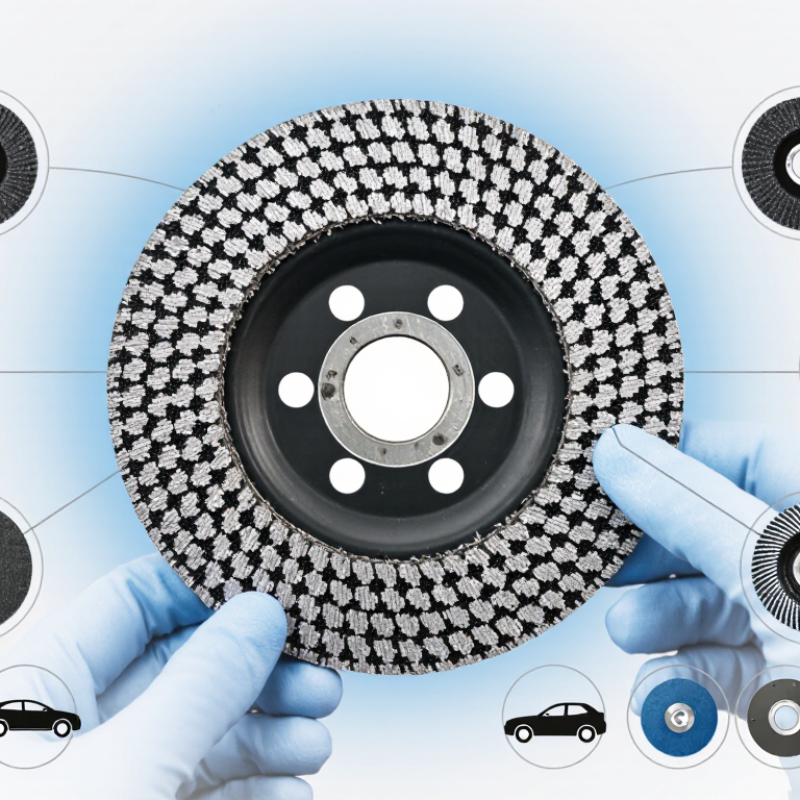
Hook-and-loop abrasive discs use a simple fastening system. Tiny hooks on the backing pad grip fabric loops on the disc. Pressure creates the hold, while a quick pull removes the disc. The disc spins on a random orbital sander, and abrasive grains cut paint, wood, primer, or metal. Common grains include aluminum oxide, zirconia, and ceramic blends. Grit controls the result: coarse grades remove material quickly, while fine grades leave a smoother surface.
The system is simple, but not foolproof. A dusty pad can weaken adhesion. Misaligned holes can also reduce dust extraction. In practical use, operators should press the disc evenly and replace it when the edge curls. Abrasive life depends on grain quality, backing strength, pressure, and workpiece hardness. More pressure does not always mean faster sanding.
Industry data shows why this product category matters. Grand View Research estimated the global abrasives market at approximately US$44 billion in 2023, with continued growth expected through 2030. A separate coated abrasives analysis by Future Market Insights projects steady expansion during the next decade. These figures include many abrasive formats, not discs alone. That limitation matters. For Chinese manufacturers, buyers should examine grit consistency, hook durability, hole accuracy, batch testing, and documented quality systems. Cheap discs may perform well briefly. Then the backing fails.
China’s leading Velcro abrasive disc manufacturers are usually identified by process control, not production volume alone. Experienced factories produce discs with stable hook-and-loop backing, even abrasive coating, and accurate hole patterns. Common sizes include 125 mm and 150 mm, with six, eight, or no dust holes.
Reliable manufacturers often support aluminum oxide, silicon carbide, and ceramic grain options. They can adjust grit ranges for sanding wood, primer, painted surfaces, or metal edges. During supplier checks, buyers should request coating samples, backing adhesion data, and batch inspection records. A disc that removes material quickly but tears after several minutes is not a strong product.
Many capable factories provide OEM packaging, private labels, and export documentation. Their technical teams should explain bond strength, heat resistance, and storage conditions clearly. This practical communication matters when testing abrasive discs in real workshops. Ask for samples from different production batches.
No factory is perfect. Some suppliers show impressive samples but provide weaker mass production. Others offer low prices while using inconsistent hook fabrics. This is where independent testing becomes valuable. Check sanding speed, dust extraction, edge wear, and disc replacement time. A small trial can reveal more than a polished catalog. Leading manufacturers earn trust through repeatable results, transparent quality records, and responsive after-sales support.
China’s leading Velcro abrasive disc manufacturers differ less in catalog size than in process control. Grand View Research’s 2024 abrasives market analysis valued the global market at more than USD 45 billion, with steady industrial demand. That growth raises a practical question: can suppliers repeat the same cutting performance across large orders?
Quality starts with measurable details. Top factories control abrasive grain distribution, resin coverage, backing flexibility, and hook density. A 125 mm disc should remain flat after conditioning, not curl at the edge. Buyers should request grit verification against FEPA or ANSI standards, peel-strength records, and cycle testing on steel or coated panels. ISO 9001 certification helps, but it does not prove every disc performs well. That distinction is often missed.
Capacity requires evidence, not impressive photographs. Industry supply-chain reports from Mordor Intelligence identify Asia-Pacific as the dominant abrasive production region, supported by broad converting and export networks. However, capacity can hide bottlenecks. Ask for monthly output by diameter, coating-line availability, inspection staffing, and recent lead-time records. A strong manufacturer may offer automated coating and slitting, while a smaller facility may provide better lot attention. Neither claim is enough alone. I would compare three production batches, not one sample box. Minor grit shedding, uneven hook placement, or a delayed replacement can reveal more than a polished audit document.
Quality and capacity comparison based on normalized industry benchmarks. A score of 100 represents the strongest benchmark level for anonymous Chinese manufacturing suppliers; no company or brand data is shown.
The comparison considers production capacity, quality consistency, grit and backing customization, inspection control, and export readiness. These indicators reflect commonly published manufacturing requirements for hook-and-loop abrasive discs, including aluminum oxide or silicon carbide abrasives, hook-and-loop backing, multiple grit options, and standardized quality inspection.
China-made abrasive discs serve several demanding industries, not one narrow market. Metal fabrication uses them for weld blending, edge preparation, and stainless-steel finishing. Automotive workshops use hook-and-loop discs on body panels, primer, and repair coatings.
China produced 31.28 million vehicles in 2024, according to the China Association of Automobile Manufacturers, creating substantial demand for controlled surface preparation.
Construction and ship maintenance also rely on these discs. Workers remove rust from structural steel, prepare painted surfaces, and smooth cut edges on site. In furniture production, abrasive discs refine solid wood, plywood, and coated panels before painting.
Electronics and precision equipment manufacturing require finer grits for controlled finishing, although disc selection must match heat sensitivity and surface tolerance. Dust matters too.
Grand View Research valued the global abrasives market at approximately US$46 billion in 2023 and forecasts continued growth through 2030. Its application analysis identifies metalworking and automotive production as major demand areas.
However, market size does not guarantee uniform product quality. That assumption fails. Buyers should verify abrasive grain, backing strength, hook adhesion, dust extraction performance, and actual cutting life.
A disc that costs less may wear faster or leave inconsistent scratches. Small batch testing remains sensible, especially for aerospace parts, stainless steel, and painted panels.
Supplier documentation should include grit standards, batch traceability, and recommended operating speeds. Some purchasing teams still judge discs by price alone. That needs reconsideration.
Choosing a Chinese manufacturer for hook-and-loop abrasive discs requires more than comparing quotations. Buyers should inspect production experience, abrasive grain knowledge, and quality controls. Ask how the factory manages backing cloth, resin bonding, disc balance, and hook attachment. A reliable supplier can explain each step with samples, records, and measurable tolerances. Vague answers are warning signs. Not every polished showroom reflects strong production.
Request samples made to your actual specifications. Test them on the intended metal, wood, or coating. Record cutting speed, loading, heat, and disc life. Check grit consistency under bright light. Examine the hook layer after repeated changes. Small details matter. A disc that performs well for five minutes may fail during an eight-hour shift. Ask for batch traceability, inspection reports, and a clear process for handling defects. Certification can support credibility, but it should match the factory’s current products and scope.
Evaluate communication as carefully as machinery. Technical staff should confirm grit standards, diameter tolerance, hole patterns, packaging, and moisture protection. Request a video audit or independent factory inspection before large orders. Compare lead times using realistic quantities, not attractive trial figures. Pricing deserves scrutiny too. Unusually low prices may indicate weaker backing, lower abrasive content, or unstable process controls. Buyers often focus on unit cost and overlook replacement waste. That mistake is expensive. Review performance after every shipment, because even a trusted supplier may need correction.
| Evaluation Dimension | Recommended Weight | What Buyers Should Check | Reliable Evidence or Measurable Data | Practical Selection Benchmark |
|---|---|---|---|---|
| Product Size and Compatibility | 10% | Confirm disc diameter, hole pattern, backing type, and compatibility with the buyer’s random orbital sander or sanding system. | Technical drawings, product samples, diameter tolerance records, and backing specifications. | The supplier should provide dimensions in millimetres and clearly identify the hook-and-loop attachment system. |
| Grit Range and Abrasive Standards | 12% | Check whether the available grit range covers the intended applications, such as paint removal, surface preparation, blending, and finishing. | Grit designation, abrasive material description, sample discs, and test results based on a recognized grading system such as FEPA or CAMI. | The manufacturer should state the applicable grit standard instead of using only commercial terms such as “coarse” or “fine.” |
| Abrasive Grain and Coating Technology | 14% | Evaluate the abrasive grain type, coating uniformity, electrostatic or mechanical coating process, and resistance to premature loading. | Technical data sheets, microscopy or coating inspection records, and comparative sanding tests on the target material. | Request the same disc specification from at least two production lots to compare cutting consistency and surface finish. |
| Backing Strength and Flexibility | 12% | Assess whether the paper, film, cloth, or hybrid backing suits the required pressure, contour, and operating speed. | Tear-resistance data, flexibility samples, backing thickness, and performance tests under the intended sanding conditions. | Film-backed discs are commonly selected when smooth finishing and dimensional consistency are important; the final choice should be sample-tested. |
| Hook-and-Loop Attachment Quality | 10% | Check attachment strength, repeated removal performance, hook coverage, disc alignment, and resistance to edge lifting. | Peel or shear test results, repeated attachment trials, visual inspection of hook coverage, and compatibility testing with the buyer’s pad. | The disc should remain securely attached during operation while still allowing normal removal without damaging the backing. |
| Dust Extraction and Hole Configuration | 8% | Match the hole pattern to the sanding pad and dust-extraction system. A mismatch can reduce extraction efficiency and increase loading. | Hole-pattern drawings, pad compatibility charts, dust-extraction trials, and finished-disc inspection records. | Approve the exact hole layout with a physical sample before placing a large order. |
| Manufacturing and Process Control | 12% | Review control of raw materials, coating, drying, die-cutting, hook-and-loop lamination, packaging, and final inspection. | Process flow chart, inspection plan, batch records, calibration records, and corrective-action documentation. | A documented inspection process should cover grit, diameter, hole position, adhesion, appearance, and packaging quantity. |
| Quality Management and Compliance | 8% | Verify the quality-management system and any regulatory or customer-specific requirements for the destination market. | Current certificates issued by an accredited certification body, audit reports, declarations, and product safety documentation where applicable. | Certificates should be checked for scope, validity, issuing body, and whether they apply to the actual manufacturing site. |
| Production Capacity and Lead Time | 8% | Assess whether the supplier can support trial orders, repeat orders, seasonal demand, and customized sizes or hole patterns. | Declared monthly capacity, production schedule, standard lead time, sample lead time, and historical delivery records. | Use a written production schedule and define the required delivery date, inspection date, and shipment date separately. |
| Minimum Order Quantity and Customization | 6% | Compare minimum order quantities for standard products, private-label packaging, special hole patterns, and customized dimensions. | Formal quotation, tooling charges, sample fees, packaging specifications, and written terms for artwork approval. | A suitable manufacturer should distinguish standard-stock pricing from customized-production pricing. |
| Packaging and Storage Protection | 4% | Check protection against humidity, contamination, deformation, abrasion, and incorrect grit mixing during storage and transport. | Packaging drawings, carton specifications, moisture-control procedures, batch labels, and shipping photographs. | Each package should identify size, grit, hole pattern, quantity, batch or lot information, and production date when required. |
| Commercial Transparency and After-Sales Support | 6% | Evaluate quotation clarity, response time, sample policy, complaint handling, replacement policy, and communication during production. | Signed quotation, approved sample, quality agreement, response-time commitments, and documented claim procedure. | The supplier should define acceptance criteria, evidence requirements, corrective-action timing, and responsibility for non-conforming goods. |