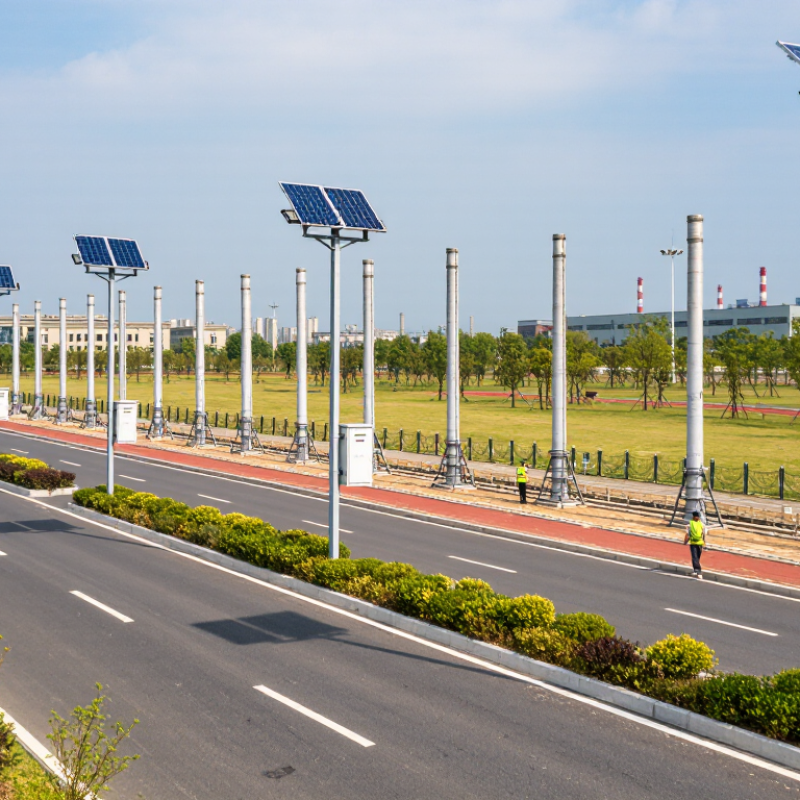
China Top Solar Energy Light Pole Manufacturers?

Choosing among China’s top solar energy light pole manufacturers requires more than comparing online prices. Buyers need reliable evidence, practical experience, and clear technical information. A strong manufacturer should explain product design, production capacity, testing methods, and after-sales support without making vague promises.

The right pole combines a solar panel, LED fixture, battery, controller, and galvanized steel structure. Each component affects performance. For example, a coastal project may need stronger corrosion protection. A rural road may require larger battery capacity during cloudy periods. Ask for lighting simulations, battery specifications, wind-load data, and installation guidance. Real project photos help, but they should include locations, dates, and measurable results.

Experience matters. A manufacturer serving roads, parks, campuses, and industrial sites usually understands different lighting demands. Factory audits can reveal welding quality, coating thickness, assembly procedures, and quality-control records. Certifications and test reports also deserve careful review. However, documents alone are not enough. One supplier may offer attractive specifications but lack dependable replacement parts.

No shortlist is perfect. Product performance can change with weather, installation quality, and maintenance habits. Buyers should compare total ownership costs, not only the initial quotation. A dependable partner communicates clearly, identifies technical limits, and accepts reasonable questions. This guide examines leading Chinese manufacturers through product quality, engineering capability, customization, delivery reliability, and customer support. The goal is practical selection, although independent verification remains necessary before signing any contract.

China Top Solar Energy Light Pole Manufacturers?

China’s Solar Lighting Market in Context: 216.9 GW of PV Added in 2023

China Top Solar Energy Light Pole Manufacturers?

China’s solar lighting market sits within an enormous photovoltaic expansion. The National Energy Administration reported 216.9 GW of new solar capacity in 2023. China’s cumulative PV capacity reached about 609.5 GW by year-end. These figures show a mature supply chain, but they do not automatically prove that every solar light pole is reliable.

The details matter. A qualified manufacturer should document battery capacity, charging performance, LED output, and autonomy during cloudy weather. Independent testing should cover ingress protection, corrosion resistance, and mechanical impact. For coastal roads, powder coating alone may be insufficient; salt exposure can attack fasteners and battery housings. Field experience also suggests that poor battery thermal management remains a common weakness.

China’s photovoltaic supply scale can reduce component costs and shorten production cycles. The IEA’s Renewables 2024 analysis also identified China as the dominant force in global renewable capacity growth. However, procurement teams should avoid treating factory scale as product evidence.

A solar pole installed in northern winters faces different risks from one installed in humid southern regions. Ask for test records, sample inspections, warranty conditions, and real project references. Some specifications still look impressive on paper, yet nighttime performance declines sharply after several cloudy days. That gap deserves more attention.

Solar Light Pole Design: LED Efficacy, PV Sizing, and 3–5 Days of Autonomy

China Top Solar Energy Light Pole Manufacturers?

Solar light pole design starts with measured lighting demand, not panel size. LED efficacy often reaches 130–180 lumens per watt in commercial roadway systems. The U.S. Department of Energy’s Solid-State Lighting R&D Opportunities report notes that laboratory LED packages can exceed 200 lumens per watt, but complete fixtures perform lower. Optics, drivers, heat, and dirt reduce real output. Leave room for that gap.

A practical design calculates nightly energy first: fixture watts × operating hours × dimming profile. Then include battery, controller, wiring, and temperature losses. For example, a 40-watt fixture operating 12 hours nightly uses 480 watt-hours before losses. With 85% system efficiency, demand approaches 565 watt-hours. Three to five days of autonomy therefore requires roughly 1.7–2.8 kilowatt-hours of usable battery capacity. Cold conditions may require more. Batteries dislike optimism.

PV sizing should use local peak-sun-hour data, not annual averages alone. The World Bank’s Global Solar Atlas provides site-specific solar resource estimates, while NREL PVWatts supports preliminary yield checks. A 40-watt system may need about 150–250 watts of PV, depending on latitude, winter irradiation, shading, and battery recovery targets. IEA PVPS Trends 2024 reported 2023 global solar additions above 400 gigawatts, showing rapid deployment, but scale does not replace field verification. Snow, dust, and tree growth still challenge otherwise sound designs. Test one pole through winter before repeating hundreds.

Key Manufacturing Standards: IP65, IEC 60598-1, and ISO 9001 Compliance

China’s solar light-pole sector is expanding with worldwide renewable demand. IRENA reported 345 gigawatts of new solar capacity in 2023. This growth makes manufacturing verification increasingly important for municipal and rural lighting projects.

IP65 should be more than a printed marking. Under IEC 60529, the first rating confirms dust-tight protection, while the second resists water jets. Inspectors should check enclosure seals, cable glands, drainage paths, and sample test records. Rain can enter through a poorly compressed gasket. The light may still operate, but corrosion has already started.

IEC 60598-1 defines general safety requirements for luminaires, including wiring, insulation, temperature, and mechanical construction. A compliant solar pole should show traceable component tests, not only a laboratory certificate. ISO 9001 supports controlled purchasing, production records, corrective actions, and final inspection. The ISO Survey 2022 recorded about 1.26 million ISO 9001 certificates worldwide, yet certification alone does not guarantee durable outdoor lighting.

No factory is flawless. Practical audits sometimes find inconsistent torque, missing test photos, or unsealed cable entries. Buyers should request batch records and repeat inspections. A 72-hour lighting test is useful, but it cannot replace weatherproofing and electrical safety verification. The strongest manufacturers connect IP65 testing, IEC 60598-1 procedures, and ISO 9001 controls throughout production.

How to Evaluate China’s Top Manufacturers: Capacity, Certifications, and Warranty

China’s top solar light pole manufacturers should be assessed through evidence, not factory size alone. IRENA’s Renewable Capacity Statistics 2024 recorded 1,419 GW of global solar capacity by the end of 2023. This growth increases supplier competition, but capacity claims still need verification. Request audited production figures, monthly shipment records, assembly-line photographs, and traceability for batteries, controllers, panels, and LEDs. A large showroom proves little.

Certifications should match the complete system and destination market. ISO 9001 supports quality management, while ISO 14001 indicates environmental controls. IEC 61215 and IEC 61730 relate mainly to photovoltaic modules; IEC 62619 can support industrial battery safety evaluation. Lighting products may also require IEC 60598 testing, EMC reports, and market-specific compliance documents. Check certificate numbers directly with issuing bodies. Expired certificates are common, and that detail is easy to miss.

Warranty terms reveal operational maturity. Ask for separate coverage periods for the battery, LED module, controller, panel, and pole structure. Require written limits for capacity loss, charging cycles, water ingress, corrosion, and replacement labor. A five-year warranty sounds strong, but it may exclude the battery or impose unrealistic inspection conditions. Request failure-rate data from comparable projects, plus spare-part availability for at least five years. Independent salt-spray, thermal-cycle, and ingress tests add confidence, although reports can still contain gaps. That imperfection deserves scrutiny.

China Top Solar Energy Light Pole Manufacturers? - How to Evaluate China’s Top Manufacturers: Capacity, Certifications, and Warranty

Evaluation Dimension Key Metric Recommended Benchmark Evidence to Request Why It Matters Suggested Score
Manufacturing Capacity Production facilities and available assembly capacity Dedicated metal fabrication, powder-coating, electronics assembly, and final-testing areas; capacity should be demonstrated against the required annual project volume. Factory profile, production-line photographs or video, equipment list, capacity statement, and recent production schedule. Helps confirm that the supplier can support both initial delivery and repeat orders without excessive delays. 0–10 points
Production Quality Control Inspection coverage from incoming materials to final shipment Documented incoming inspection, in-process inspection, final inspection, sampling plan, and traceability for major components. Quality-control procedure, inspection checklist, sample inspection report, nonconformity procedure, and batch traceability records. Reduces the risk of inconsistent pole dimensions, wiring faults, battery defects, and incomplete deliveries. 0–10 points
Pole Material and Structure Material grade, wall thickness, corrosion protection, and structural design Material and dimensions must match the approved drawings and local wind-load requirements. Common options include galvanized steel, aluminum, or other corrosion-resistant structures. Material certificate, approved drawings, structural calculations, galvanizing or coating report, and dimensional inspection report. Solar poles must withstand wind, rain, vibration, foundation loads, and long-term outdoor exposure. 0–10 points
Lighting Performance Luminous output, efficacy, beam distribution, color temperature, and operating profile Require photometric data and an application-based design rather than evaluating only LED wattage. Confirm that the design meets the target illuminance or luminance level. IES or equivalent photometric file, LM-79-style test data where available, lighting simulation, LED data sheet, and approved lighting layout. Higher wattage does not automatically provide better road or area lighting; distribution and operating conditions are equally important. 0–10 points
Solar Module Module type, rated power, efficiency, and environmental durability Use a documented power calculation based on local solar resource, panel orientation, load, autonomy requirement, and seasonal conditions. Monocrystalline modules are widely used for compact solar lighting systems. Module data sheet, electrical test report, serial or batch information, warranty terms, and system-sizing calculation. Insufficient photovoltaic capacity is a common cause of poor performance during cloudy or winter periods. 0–10 points
Battery System Battery chemistry, usable capacity, cycle life, operating temperature, and protection Require a battery-management or charge-control strategy, overcharge and over-discharge protection, and a capacity calculation showing the required nights of autonomy. LiFePO₄ batteries are commonly selected for outdoor solar lighting because of their thermal stability and cycle-life characteristics. Battery data sheet, capacity test, safety documentation, BMS or controller specification, autonomy calculation, and replacement procedure. The battery is often the component most directly associated with nighttime runtime and lifecycle cost. 0–10 points
Autonomy and Energy Design Runtime under normal and low-sun conditions Evaluate the design using local solar irradiation, seasonal conditions, dimming schedule, battery usable capacity, and the specified number of backup nights. Do not accept runtime claims without calculation assumptions. Energy-balance calculation, solar-resource assumptions, dimming schedule, battery sizing sheet, and project-specific performance simulation. Provides a more realistic comparison than a simple advertised “hours of lighting” figure. 0–10 points
Ingress and Impact Protection Protection of luminaire, controller, battery enclosure, and junction box IP65 or higher is a practical minimum for exposed outdoor enclosures; IP66 provides stronger protection against water jets. Consider IK08 or higher where mechanical impact is a concern. IP and IK test reports from a competent laboratory, enclosure drawings, gasket specifications, and installation instructions. Appropriate protection helps prevent water ingress, dust contamination, corrosion, and accidental damage. 0–10 points
Electrical and Photobiological Safety Applicable safety, EMC, and photobiological-risk assessment Request conformity evidence relevant to the destination market. IEC 60598-1 is a key general luminaire safety reference; IEC 62471 addresses photobiological safety; EMC requirements should also be considered. Test reports, declarations of conformity, circuit diagrams, insulation or dielectric test records, grounding details, and EMC documentation. Confirms that the electrical design has been assessed for shock, fire, electromagnetic compatibility, and optical safety risks. 0–10 points
Management Certifications Quality, environmental, and occupational-health management systems ISO 9001 certification is a useful quality-management indicator. ISO 14001 and ISO 45001 may be relevant for environmental and occupational-health management. Certificates should be current and issued for the actual manufacturing site. Current certificates, certification scope, certificate number, issuing body, validity date, and verification record. Management-system certification supports process consistency but does not replace product-specific testing. 0–10 points
Product Compliance Compliance with destination-country requirements Product documentation must match the target country, voltage system, installation rules, and applicable electrical, lighting, and construction regulations. Country-specific conformity documents, labels, user manuals, installation instructions, risk assessment, and customs documentation. A product can be technically functional yet unsuitable for import, installation, or public-sector approval in a particular market. 0–10 points
Testing and Reliability Environmental, thermal, charging, cycling, and endurance testing Prioritize project-specific testing covering charging and discharging, temperature exposure, water ingress, corrosion, LED thermal behavior, and repeated operating cycles. Test plan, laboratory reports, accelerated-aging records, temperature test data, battery-cycle results, and corrective-action records. Reliability testing identifies failure modes that may not be visible during a short demonstration. 0–10 points
Warranty Coverage period, exclusions, response time, and replacement responsibility Compare the warranty separately for the LED luminaire, solar module, battery, controller, and pole structure. A clear written warranty with defined remedies is more valuable than an unsupported long-term claim. Signed warranty document, component-specific terms, spare-parts policy, claim procedure, response-time commitment, and examples of after-sales records. Component-specific terms reveal whether the supplier accepts responsibility for the parts most likely to require replacement. 0–10 points
After-Sales Service Technical support, spare parts, troubleshooting, and field assistance Require installation manuals, wiring diagrams, controller settings, troubleshooting guidance, and a defined escalation process. Confirm the availability of replacement batteries, controllers, LED modules, and hardware. Service-level agreement, spare-parts list, training materials, remote-support process, and service contact details. Good support can significantly reduce downtime and maintenance costs after installation. 0–10 points
Project Experience Experience with similar climate, site conditions, and deployment scale Prior projects should be comparable in climate, wind conditions, lighting class, installation quantity, autonomy requirement, and maintenance environment. Redacted project references, installation photographs, commissioning reports, performance records, and customer references where permitted. Relevant experience is more useful than a general claim of long operating history. 0–10 points
Commercial and Delivery Capability Lead time, minimum order quantity, packaging, shipping, and change control Supplier should provide a written production schedule, agreed inspection points, export packaging specification, spare-parts allowance, and procedures for engineering changes. Quotation, pro forma invoice, production schedule, packing specification, inspection plan, and change-control terms. Clear commercial controls reduce delivery risk and prevent unapproved substitutions. 0–10 points
Verification Recommendation Independent validation before mass production Use an approved sample, third-party factory audit, pre-shipment inspection, and project-specific functional test before releasing the full order. Signed technical specification, approved golden sample, audit report, inspection report, and acceptance-test record. Independent verification converts supplier claims into measurable acceptance criteria. Pass / Conditional Pass / Fail

Applications and Lifecycle Economics of Solar Street Light Poles

Solar street light poles are increasingly used on rural roads, campuses, parking areas, and industrial entrances. The best manufacturers focus on more than attractive specifications. They study local sunlight, soil conditions, wind loads, traffic patterns, and maintenance access before designing a pole system.

Lifecycle economics often matters more than the purchase price. A dependable system combines a corrosion-resistant pole, efficient LED lighting, a correctly sized battery, and a reliable controller. For example, a road requiring ten hours of nightly lighting may need larger storage during cloudy seasons. Replacing batteries every few years can exceed the original installation cost. However, poor installation can still reduce performance, even with quality components. That part is sometimes underestimated.

Tips: Request a five-year cost estimate, including batteries, cleaning, inspections, transport, and replacement labor. Ask for test data covering battery cycles, wind resistance, waterproofing, and LED performance. Check whether technicians can access the battery without removing the entire pole. Small details matter. Select lighting levels based on actual pedestrian and vehicle activity, not exaggerated brightness. A pilot installation can reveal shadows, weak charging, and unexpected maintenance problems before full deployment. Consider recyclable materials and responsible end-of-life handling. These choices may raise initial costs slightly, but they can improve reliability and reduce waste over the system’s working life.

Solar Street Light Pole Applications and 10-Year Lifecycle Economics

Modeled lifecycle cost per pole for a 10-year period, using realistic engineering assumptions and excluding company or brand data.

Model assumptions

Solar system: 100 W LED luminaire, 12 operating hours per night, lithium battery replacement during year 6, and no grid electricity cost. Grid-connected system: the same 100 W LED luminaire, electricity at US$0.12/kWh, 10-year energy consumption of approximately 4,380 kWh, plus typical trenching and connection costs. Costs are indicative market-based estimates in 2026 US dollars and vary by project location, pole height, battery capacity, labor, and energy tariffs.

Article Source:

t