China has become a major sourcing destination for art printing, serving publishers, galleries, museums, brands, and independent artists worldwide. Its manufacturing base combines offset expertise, digital production, specialty papers, and increasingly automated finishing. The opportunity is substantial. Smithers’ The Future of Global Printing to 2028 identifies digital print and premium applications as important areas of industry development. These trends support demand for short runs, personalized editions, and sharper image reproduction.
Quality remains the real test.
Global buyers must evaluate more than attractive factory photos. Reliable manufacturers should demonstrate color management procedures, press calibration records, material traceability, and documented inspection standards. ISO 12647 guidelines provide a useful reference for process control in commercial printing. FSC certification can also help buyers verify responsible paper sourcing, although certification must be checked for the specific facility and product scope. FESPA’s 2023 Print Census further highlights automation, digital workflows, and production efficiency as continuing priorities among professional printers.
This guide examines leading Chinese art printing manufacturers through practical purchasing criteria. These include paper selection, pigment or offset ink performance, proofing accuracy, binding strength, packaging protection, minimum order quantities, and export communication. A museum-quality print should preserve fine skin tones, subtle shadows, and clean edge details. A poorly controlled batch may fail despite a competitive quotation.
Some suppliers excel at luxury books. Others perform better with posters, giclée editions, canvas, or rapid prototypes. No manufacturer is perfect. Buyers should request physical samples, confirm tolerances, and compare final proofs before placing large orders. Transparent communication remains essential, especially when color expectations differ across screens, papers, and viewing environments.
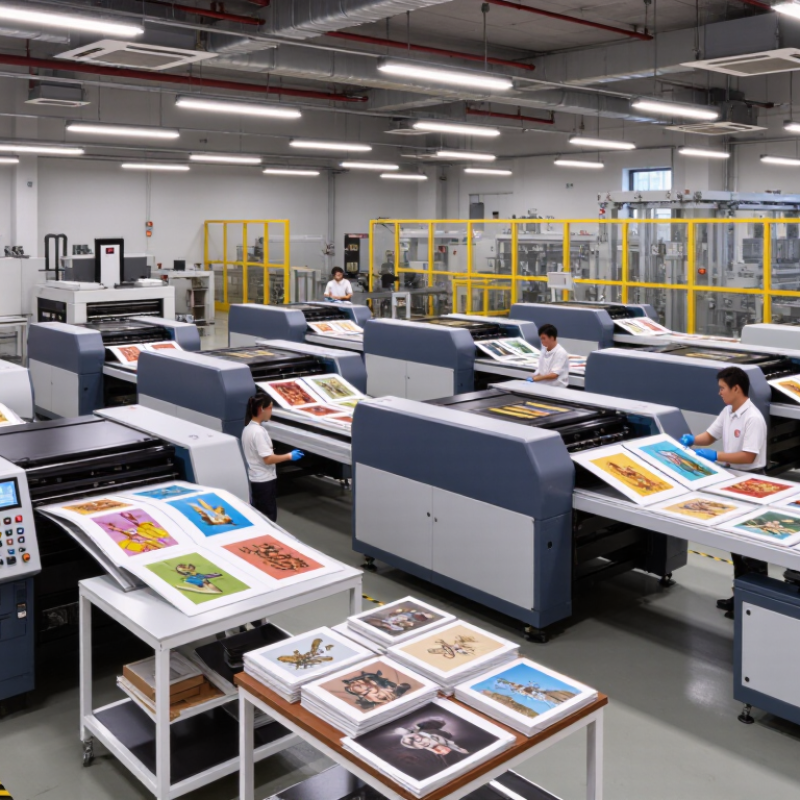
China’s art printing manufacturing industry supports museums, galleries, publishers, and independent creators worldwide. Many factories combine digital prepress, offset printing, fine-art reproduction, and hand-finishing under one roof. Production may include archival paper, canvas, textured stock, foil details, and carefully trimmed editions.
Quality begins with color management. A reliable manufacturer uses calibrated screens, controlled lighting, and physical proofs before mass production. During a factory assessment, buyers should inspect paper storage, printer maintenance, and packaging methods. Printed colors can shift between a monitor and a finished sheet. That small difference matters. Experienced suppliers explain these risks instead of promising perfection.
Tips: Request a press proof before approving production. Ask for paper samples from the same batch. Confirm color standards, tolerances, dimensions, and delivery terms in writing. Check how prints are protected from moisture and abrasion. Keep approved samples for later comparison. Do not rely on digital images alone.
Reliable manufacturers maintain documented quality checks at prepress, printing, finishing, and packing stages. Buyers should request process records, material specifications, and evidence of responsible workplace practices. The cheapest quote may hide weak color control or careless packaging. Factories also vary in communication speed and technical judgment. A supplier that raises a file-resolution problem early is often more dependable than one that accepts every file silently. No factory gets every shade perfect. That is why clear proofing and honest review remain essential.
Selecting an art printing manufacturer requires more than comparing quotations. The Art Basel and UBS Art Market Report 2024 valued global art sales at approximately $65 billion in 2023. That scale increases demand for consistent color, dependable delivery, and documented quality. Request calibrated proofs before production. Compare skin tones, shadow detail, neutral grays, and fine lines under controlled lighting. A beautiful sample is not enough.
Check whether the factory follows recognized color-management practices, such as ISO 12647 targets or equivalent internal controls. Ask for recent test records, ink specifications, paper certificates, and accelerated-aging results. Archival performance matters for limited editions and museum-quality reproductions. The Fine Art Trade Guild’s standards also emphasize lightfastness, labeling, and material disclosure. These details reveal professional discipline. They also expose weak processes.
Capacity must be verified, not assumed. Review monthly output, peak-season staffing, inspection points, and backup equipment. The Smithers report on digital print for fine art, photography, and décor identifies continued growth in digitally produced decorative and artistic applications, making scalability increasingly important. Still, growth forecasts cannot guarantee one supplier’s performance. I would test a small batch first. Measure color difference, trimming accuracy, packaging damage, and delivery time. Then negotiate from evidence, not optimism. Mistakes happen. Transparent correction procedures matter more than polished promises.
China Top Art Printing Manufacturers for Global Buyers
Art printing manufacturers in China serve different needs, and the right type depends on the artwork, quantity, and surface. Fine art giclée manufacturers use pigment inks on cotton paper or canvas. They suit galleries, photographers, and limited editions requiring subtle color transitions.
Offset printing manufacturers are more practical for art books, exhibition catalogs, and large paper runs. Their strengths include stable registration, accurate folding, and lower unit costs at higher volumes. Screen printing manufacturers create stronger ink coverage on posters, textiles, and specialty papers. Each layer is applied separately. That process feels slower, but it gives the artwork a distinctive physical depth.
Digital art printing manufacturers support short runs, personalization, and frequent design changes. Global buyers often use them for market testing before ordering thousands of copies. Experienced suppliers should provide prepress checks, calibrated proofs, color references, and documented inspection points. Ask how they control paper moisture, ink adhesion, cutting tolerance, and packaging during export. Small details matter.
No factory is perfect. A beautiful sample may hide weak corner protection or inconsistent batch color. I have seen buyers approve screens online and regret ignoring a physical proof. Request production samples, material data, and clear defect standards before payment. Environmental claims also need evidence, such as traceable paper sourcing and responsible ink handling, rather than attractive wording alone.
Color-channel ranges reflect common production configurations used in commercial art printing. Giclée and digital inkjet printing typically support more color channels for detailed tonal reproduction, while offset and screen printing are widely used for scalable production.
China’s leading art printing manufacturers are judged by measurable control, not attractive samples alone. Smithers’ 2024 report forecasts digital print growth at about 5% annually through 2029. This trend raises buyer expectations for short runs, accurate color, and repeatable production.
Quality begins with ISO 12647 process targets and documented proofing. Reliable factories record ink density, color difference, drying time, and sheet moisture. A practical tolerance is often ΔE00 below 3 for critical colors. Fogra process-control guidance also supports standardized test forms and measurement devices. Small errors become visible on large art prints.
Material selection needs equal attention. Cotton paper, alpha-cellulose stock, canvas, and synthetic sheets absorb ink differently. Archival buyers should request acid-free materials, lightfast pigment inks, and permanence test results. Grand View Research’s 2024 market analysis indicates steady growth in fine-art printing demand, supported by premium personalized products. That demand can encourage rushed production. It happens.
Strong manufacturers separate proofing, printing, coating, trimming, and final inspection. They should provide batch records, substrate specifications, and packing tests for overseas shipping. However, no factory can promise perfect color across every material. Humidity, monitor settings, and viewing light still influence judgment. A thoughtful supplier explains these limits before production, rather than hiding them after delivery.
| Evaluation Dimension | Typical Specification or Capability | Relevant Quality Standard or Control Point | Global Buyer Consideration |
|---|---|---|---|
| Offset lithographic printing | Suitable for high-volume art books, exhibition catalogs, posters, and reproductions requiring consistent color across large runs. | Prepress proof approval, calibrated color workflow, ink-density checks, registration control, and press-sheet inspection. | Usually more economical than digital printing when the quantity is large and the artwork is finalized. |
| Digital printing | Appropriate for short runs, personalized editions, prototypes, and print-on-demand projects with limited setup requirements. | Color consistency between batches, file-resolution checks, variable-data verification, and sample approval. | Can reduce inventory risk, although unit cost may be higher for very large quantities. |
| Fine-art reproduction | High-resolution scanning or photography, color correction, proofing, and reproduction on coated or archival-grade papers. | ICC color management, controlled lighting for inspection, approved contract proof, and documented artwork handling. | Buyers should confirm the required color profile, viewing conditions, proof format, and image-retention expectations. |
| Paper and board selection | Common options include uncoated art paper, coated paper, textured paper, recycled paper, and rigid board for covers or packaging. | Basis weight, caliper, opacity, surface smoothness, moisture condition, and lot-to-lot consistency should be checked. | The paper surface affects ink absorption, color density, image sharpness, folding behavior, and perceived artwork value. |
| Paper weight range | Commercial art-print projects commonly specify paper by grammage, often approximately 80–350 g/m² depending on the product structure. | Actual grammage and caliper should be verified against the approved sample and purchase specification. | Higher grammage is not automatically better; folding, binding, shipping weight, and postal requirements must also be considered. |
| Color management | CMYK production workflows are standard for process-color printing; spot colors may be specified for brand or special-color accuracy. | Use of an agreed ICC profile, color bar monitoring, proof-to-print comparison, and tolerance acceptance criteria. | RGB artwork should be converted or managed through an agreed workflow before production to avoid unexpected color shifts. |
| Finishing options | Available processes may include aqueous coating, matte or gloss lamination, varnish, foil stamping, embossing, debossing, die-cutting, and edge treatment. | Check adhesion, scuff resistance, registration, surface uniformity, foil coverage, and compatibility with folding or binding. | Finishing can improve appearance and durability but may increase lead time, tooling cost, and minimum order quantity. |
| Binding and assembly | Common methods include saddle stitching, perfect binding, sewn binding, case binding, spiral or wire binding, and lay-flat structures. | Page sequence, trim accuracy, spine formation, adhesive application, thread tension, and opening performance should be inspected. | The selected method should match page count, paper thickness, opening angle, product lifespan, and presentation requirements. |
| Sustainable material options | Recycled-content papers, responsibly sourced papers, water-based or low-odor coatings, and recyclable packaging may be available. | FSC certification applies to certified forest-based material; recycled-content claims should be supported by supplier documentation. | Certification scope, certificate validity, chain-of-custody details, and claim wording should be verified for the specific order. |
| Prepress and file preparation | Typical checks include bleed, trim marks, embedded fonts, image resolution, overprint settings, transparency, and color-space conversion. | A signed digital proof or physical contract proof should be approved before mass production. | Providing print-ready PDF files with clear trim, bleed, and color instructions helps reduce rework and production delays. |
| Quality inspection | Inspection commonly covers dimensions, color, registration, paper defects, finishing, binding, packaging, and quantity. | ISO 9001 is a quality-management-system standard; product acceptance criteria still need to be defined in the purchase order. | An approved sample, inspection checklist, defect classification, and sampling plan provide clearer acceptance decisions. |
| Packaging for export | Protective wrapping, corner protection, cartons, pallets, moisture barriers, and shipping marks can be specified for international delivery. | Packaging should protect against abrasion, compression, moisture, and movement during multimodal transport. | Confirm carton dimensions, gross weight, pallet configuration, labeling, and any destination-country packaging rules. |
| Production planning | A normal workflow includes quotation, technical review, proofing, material procurement, printing, finishing, inspection, packing, and shipment. | Lead time depends on quantity, paper availability, proof approval, finishing complexity, binding, and export arrangements. | Buyers should request a written schedule with approval deadlines, production milestones, inspection timing, and delivery terms. |
Note: Specifications shown are common industry ranges and control practices rather than commitments from any individual manufacturer. Confirm materials, certifications, tolerances, sampling requirements, and lead times against the final quotation and purchase order.
China Top Art Printing Manufacturers for Global Buyers
How to Select and Work With a China-Based Printing Partner
Choosing a China-based art printing partner requires more than comparing unit prices. Review their experience with your paper type, color standards, binding method, and order volume. Ask for recent sample books, not only digital images. Samples reveal more. Check edge trimming, ink density, paper texture, and packaging strength under normal handling. A reliable manufacturer should explain production limits clearly and provide measurable specifications.
Request a written quotation with plate costs, proofing fees, packing details, shipping terms, and replacement policies. Confirm whether the factory manages prepress, printing, finishing, and inspection directly. Video calls can show the production floor, but they are not enough. Request batch photos and an inspection report before shipment. One overlooked detail can affect thousands of copies. For artwork, send color references, bleed settings, font files, and a signed proof. Keep every revision dated.
Communication needs structure. Use one shared specification sheet and approve changes in writing. Allow time for humidity-related paper changes and international transport delays. A factory may promise a fast schedule, yet holiday demand or material shortages can shift it. That risk deserves honest discussion. I would also test a modest first order before committing to a large run. It may feel inefficient. However, this step can expose weak color matching or careless corner protection early. Maintain a practical relationship, while checking quality at every production milestone.